How Big Is the Risk of a US-Venezuela War?
How Big Is the Risk of a US-Venezuela War?
The United States has assembled its largest military force near Venezuela in decades, and the question now facing governments, markets and ordinary people in the region is a direct one: how big is the risk of a US Venezuela war? President Donald Trump has ordered a blockade of sanctioned oil tankers, United States warships are positioned in the Caribbean, and Venezuela has said it will defend itself. No ground invasion has been announced, and no war has been declared, but the risk of a direct clash has risen sharply.
Analysts who follow the region describe the situation as serious but not yet a war. The United States has carried out strikes on vessels at sea since September, and it has seized a sanctioned oil tanker. Venezuela has answered with naval escorts for its own tankers and with public warnings that it will resist pressure. The gap between those two positions is where the danger lies, because a single encounter at sea could change the course of the crisis.
The US Venezuela war risk cannot be measured with a single number. It depends on decisions made in Washington and Caracas, on the behaviour of tanker crews and naval commanders, and on whether diplomacy finds room to work. The sections below set out what is known, what is driving the risk up, what could bring it down, and what would have to happen for the confrontation to turn into a full war.
The Military Buildup Behind the US Venezuela War Risk
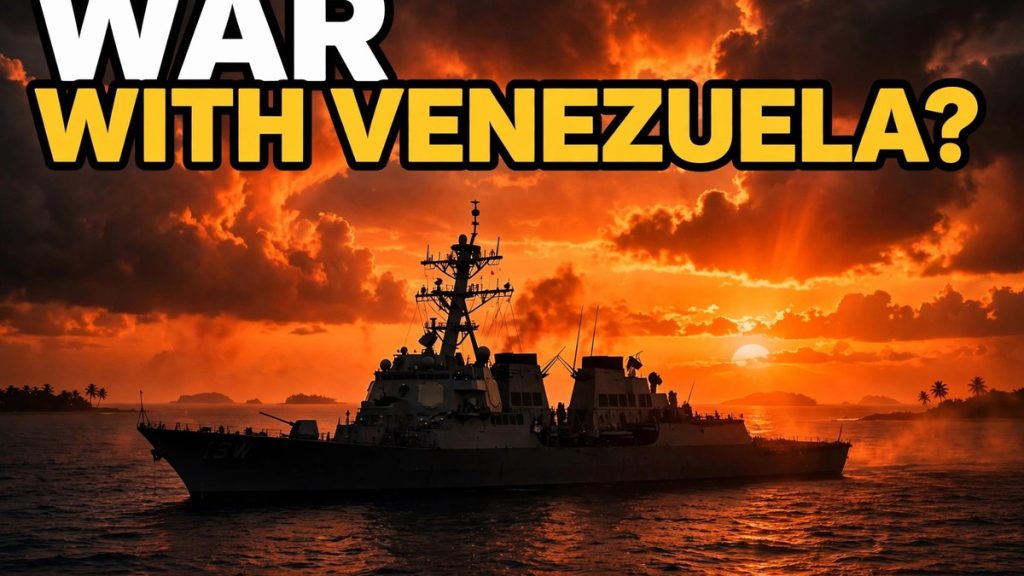
The scale of the United States deployment is the starting point for any assessment of risk. Reports put the number of warships in the Caribbean at 11, including the aircraft carrier USS Gerald R. Ford, the largest aircraft carrier in the world. Several amphibious assault ships, destroyers and support vessels were also reported to be operating in the area, along with maritime patrol aircraft.
Thousands of United States troops were reported to be in the region, with estimates of around 15,000 military personnel. That figure includes sailors, marines and air crews, as well as support staff. The deployment was described by analysts as the largest United States military buildup near Venezuela in decades, and the largest naval presence in the Caribbean in years.
The buildup did not appear overnight. United States forces had been moving ships and aircraft into the region for months, and the pace increased through the autumn. Trump described the force as the largest armada ever assembled in the history of South America. That description was his own, and it was intended to signal that Washington was prepared to use force if it chose to do so.
Venezuela has a much smaller navy and air force. Its government has relied on public warnings, naval escorts for oil tankers and appeals to other countries for support. The imbalance in military power means that a direct war would be one-sided in purely military terms, but it also means that Venezuela has fewer options for responding without taking large risks.
Strikes at Sea and the Seized Tanker
Since September, United States forces have carried out a series of strikes on vessels in the Caribbean and the eastern Pacific. Washington said the vessels were carrying drugs bound for the United States. The strikes drew scrutiny in Congress, where lawmakers from both parties asked for more information about the legal basis for the operations and the evidence behind each strike.
The administration has said the operations are lawful and that the targets were drug traffickers. Human rights groups and some lawmakers have asked for independent verification of those claims. The debate matters, because the strikes established a pattern: the United States was prepared to use lethal force against vessels at sea, without warning, on the basis of intelligence that was not published in full.
United States forces also seized a sanctioned oil tanker off the coast of Venezuela. Officials said the vessel, called the Skipper, was involved in an illicit oil shipping network and was carrying about 1.8 million barrels of oil. Officials said the tanker had been falsely flagged and was used to move oil between Venezuela and Iran. The seizure showed that Washington was prepared to take a vessel, not only to strike one.
Trump then announced a total blockade of sanctioned oil tankers going into and out of Venezuela. The announcement raised the stakes further, because a blockade is a step beyond individual seizures. Venezuela answered by deploying its navy to escort tankers leaving its main port, which created the conditions for a direct encounter between the two navies.
What Washington Says It Wants
The Trump administration has said the campaign is about stopping drugs from reaching the United States. Officials have argued that Venezuelan territory and waters are used by trafficking networks, and that pressure on the government of President Nicolas Maduro is needed to disrupt those networks. Trump has also accused Maduro of leading a drug cartel, a claim the Venezuelan government denies.
In November, the administration designated the Cartel de los Soles as a foreign terrorist organisation. The designation gave Washington additional legal tools to target people and networks it links to the group. The administration has also described the Maduro government itself as a foreign terrorist organisation in its public statements.
Trump has also demanded the return of oil, land and other assets he said had been taken from the United States. That demand goes beyond drug enforcement and points to a wider political goal.
Inside the administration, officials have given different accounts of that goal. Some have presented the campaign as a narrow operation against trafficking. Others, including White House Chief of Staff Susie Wiles in an interview published in Vanity Fair, were quoted as saying Trump wanted to keep striking boats until Maduro gave in.
That remark was read by critics as evidence that the aim was political change in Caracas. Supporters of the administration argue that pressure on the government is the only way to stop trafficking, because the government itself is part of the problem. The difference between those two accounts matters for risk, because a campaign aimed at drug boats is easier to limit than a campaign aimed at removing a government.
What Venezuela Says It Will Do
The Venezuelan government has rejected the United States threat and has said it will defend its sovereignty. In a statement, Caracas described the blockade announcement as a grotesque threat and an attempt to steal the wealth of the nation. Officials said Venezuela would not accept a naval blockade and would resist pressure from Washington.
President Maduro said Venezuela would continue its oil trade and would not be intimidated by the deployment. Venezuela deployed its navy to escort oil tankers, a move that was presented as a defence of sovereignty. The escorts also served a practical purpose: they gave tanker crews a reason to keep sailing, despite the risk of seizure.
Caracas has sought support from other countries, including China and Russia. Venezuela has oil and political ties with both countries, and officials in Caracas have pointed to those relationships as a reason why pressure from Washington would not work in isolation. Any action against tankers linked to Chinese or Russian companies would carry wider diplomatic risks, and both countries have an interest in the outcome.
Venezuela has also argued that the United States campaign is illegal under international law. That argument has been echoed by some governments in Latin America and by legal experts who note that a naval blockade is generally treated as an act of war. The legal argument does not change the balance of military power, but it shapes how other countries respond to the crisis.
Four Factors That Raise the Risk
The first factor is the presence of two navies in the same waters. United States warships and Venezuelan naval vessels are now operating close to each other, and tanker crews are sailing under escort. A misidentification, a warning shot, or a decision by a local commander could produce a clash that neither capital intended. Navies train for such situations, but the risk does not disappear.
The second factor is the blockade itself. A blockade announcement creates a test. If the United States does not enforce it, the announcement looks empty.
If it does enforce it, each seizure is a new incident that could escalate. The more seizures there are, the more chances there are for something to go wrong.
The third factor is the political goal. If the aim is only to stop drug boats, the campaign can be limited to a set of targets at sea. If the aim is to force political change in Caracas, the campaign is open-ended. An open-ended campaign is harder to end, because there is no clear point at which Washington can say the goal has been achieved.
The fourth factor is the lack of a direct channel for de-escalation. Public statements from both sides have been confrontational. Trump has said the force will only get bigger.
Maduro has said Venezuela will not give in. When public positions are that firm, it becomes harder for either side to step back without appearing weak, even if both sides would prefer to avoid war.
Four Factors That Could Lower the Risk
The first factor is that neither side has announced a ground invasion. A war would normally require troops on land, and there is no public evidence of a large-scale invasion force being assembled for Venezuela. The deployment is naval and aerial, not a ground invasion force. That distinction limits the risk, at least for now.
The second factor is the role of regional governments. Many governments in Latin America and the Caribbean have called for dialogue and for a peaceful resolution. A regional consensus against escalation would make it harder for Washington to act alone, and would give Caracas a reason to seek a negotiated outcome rather than a confrontation.
The third factor is the economic cost. A prolonged confrontation would affect oil markets, shipping insurance and regional trade. The United States, Venezuela and neighbouring countries all have an interest in avoiding a disruption that lasts for months. Economic pressure can push both sides toward talks, even when public rhetoric is hostile.
The fourth factor is the legal and political debate in Washington. Congress has raised questions about the campaign, and that debate creates a check on the executive. If Congress demands more information or imposes limits, the administration would have to weigh the political cost of continuing the campaign without broader support.
What a War Would Look Like, and What It Would Not
A full war between the United States and Venezuela would look very different from the current confrontation. It would involve strikes on land targets, a ground force, and a sustained campaign to remove the government. None of those elements has been announced. The current confrontation is limited to the sea, to sanctions and to public pressure.
A limited war is a more realistic scenario than a full invasion, if escalation occurs. That could mean strikes on land-based targets linked to drug trafficking, or a wider campaign against Venezuelan military facilities. Trump has said land operations could start soon, and that the land is easier than the sea. That statement was noted by analysts, because it suggested that the campaign could expand beyond vessels.
The most likely outcome, according to analysts who follow the region, is neither a full war nor a quick resolution. It is a prolonged standoff, with periodic seizures, public threats and diplomatic pressure, while oil continues to move through intermediaries and the Venezuelan economy continues to operate under sanctions. That outcome is not peaceful, but it is not war either.
Regional and Global Consequences
The crisis has already affected the region. Neighbouring countries are concerned about refugees, about drug trafficking routes shifting to their territory, and about the precedent set by a large United States deployment in the Caribbean. Colombia, Guyana and the Caribbean island states have all watched the buildup closely, because a conflict would affect their security and their economies.
Oil markets are also watching. Venezuela produces roughly one million barrels of oil per day, a small share of global supply, but a disruption to its exports can affect regional prices. The impact would be larger if the confrontation spread to other producers or to shipping routes in the Caribbean. Insurers have already raised premiums for some routes in the region.
The United States also faces a credibility question. If it announces a blockade and does not enforce it, its threats will carry less weight in future crises. If it enforces the blockade and the confrontation escalates, it will face questions about the cost and the legality of the campaign. That dilemma is common in coercive diplomacy, and it is one reason why the risk is hard to assess from the outside.
Frequently Asked Questions
Is the United States at war with Venezuela?
No. No war has been declared and no ground invasion has been announced. The confrontation is currently limited to a naval buildup, strikes on vessels at sea, sanctions and a blockade announcement.
What is the biggest risk of escalation?
A direct encounter at sea between United States and Venezuelan naval forces, or a seizure of a tanker that leads to deaths or retaliation, is the most immediate risk.
Why is the United States taking action?
Washington says the campaign is aimed at stopping drug trafficking and at cutting off revenue it accuses the Maduro government of using to finance crime and terrorism.
Could diplomacy still work?
Regional governments have called for dialogue, and neither side has closed the door to talks in public. A negotiated outcome would require both sides to step back from their current public positions.
What should people in the region watch for next?
Whether more tankers are seized, whether Venezuela continues to send tankers under escort, and whether the United States expands the campaign to land-based targets.
The US Venezuela war risk is real, and it has risen because a large naval force, a blockade announcement and a direct challenge to the Maduro government are now in place at the same time. A full war is not the most likely outcome, but the conditions for a serious incident at sea are present, and the next weeks will show whether pressure leads to talks or to a clash that neither side says it wants.