Houthis Strike Saudi Oil Refinery in Major Escalation
Houthis Strike Saudi Oil Refinery in Major Escalation
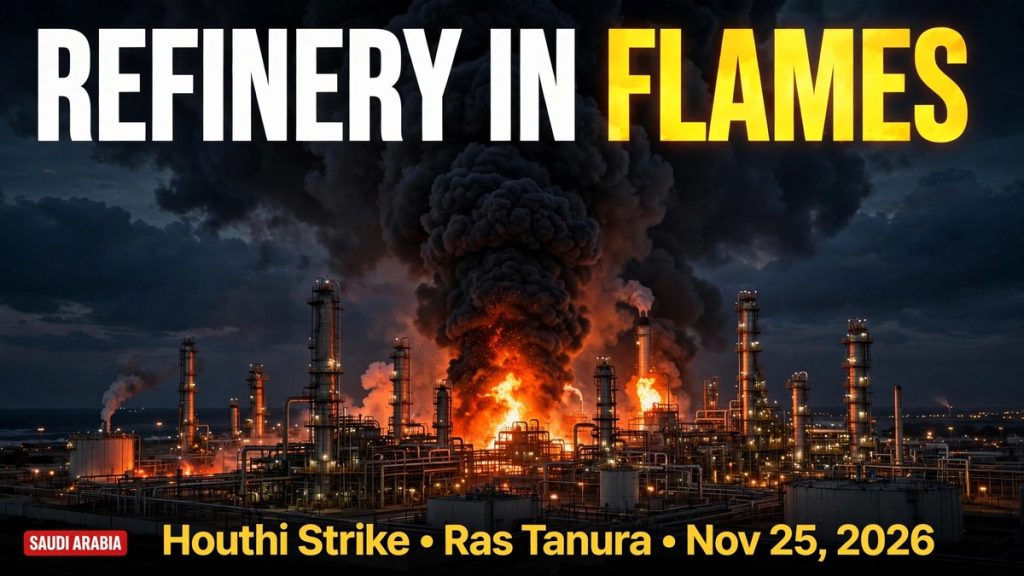
Yemen’s Houthi movement said on Wednesday, November 25, 2026, that it had attacked Ras Tanura, Saudi Arabia’s largest oil refinery, in the most serious blow to Gulf energy infrastructure in weeks. Satellite images showed thick black smoke over the installation, and oil prices jumped as traders assessed the damage to one of the world’s most important crude export terminals.
Houthi military spokesperson Yahya Saree said the strike was accurate and direct and that it caused fires at the refinery, which sits on Saudi Arabia’s Gulf coast alongside one of the world’s largest crude export terminals. The refinery can process about 550,000 barrels of oil a day.
Satellite imagery from NASA and Planet Labs, reviewed by Reuters, showed thick black smoke covering about 600 square kilometres around the refinery, roughly the size of Chicago. A source with knowledge of the matter confirmed an attack to Reuters, and Argus Media reported that both the refinery and its export terminal were hit.
The Saudi-led coalition gave a different account. Its spokesman, Major General Turki al-Maliki, said Saudi air defences intercepted and destroyed four drones over Ras Tanura on Wednesday morning, and that falling fragments caused no injuries in an initial assessment. The coalition did not confirm that the refinery itself had been struck.
A Week of Rising Attacks
The Ras Tanura claim followed a series of Houthi attacks on Saudi energy targets this autumn. The group claimed a ballistic missile attack on Ras Tanura on October 27, and three days later claimed strikes on the Ras Tanura and Rabigh refineries and Aramco’s Abqaiq facility. On November 9, an attack set fire to the East-West pipeline, which carries crude to the port of Yanbu.
Analysts at the Institute for the Study of War said the Houthis attacked the Ras Tanura refinery on November 24 as part of their ongoing campaign to compel Saudi Arabia to end military operations in Yemen and accept Houthi demands. The Houthi leadership publicly claimed the strike a day later, on November 25.
The escalation continued the next day. On Thursday, November 26, a projectile struck an oil refinery in Saudi Arabia’s southwestern Jazan region, killing a Nepalese worker and injuring several others, according to the Saudi Ministry of Energy. The strike sparked a fire and temporarily suspended some operations at the facility.
Saudi Arabia has responded with strikes of its own, including an attack on the Ras Isa refinery in Yemen, part of a major export terminal for Saudi crude. The exchange marks a sharp intensification of a conflict that had already strained energy markets across the Gulf.
Oil Prices Jump
Energy markets reacted quickly. Brent crude, the global benchmark, rose more than 2 percent on Wednesday after the Houthi claim, topping 93 dollars a barrel, and climbed further toward 95 dollars as reports of the Jazan strike emerged. Traders were pricing in the risk that further attacks could disrupt supplies from the world’s largest oil exporter.
Ras Tanura matters because of its scale. The refinery and its export terminal handle a large share of Saudi crude shipments, and any sustained disruption there would ripple through global oil markets. The smoke plume visible from space, covering 600 square kilometres, was a visible sign of the scale of the incident, even while the two sides disagreed about what exactly had been hit.
The attack also comes against the background of a wider regional war. The conflict between the United States and Iran entered its 271st day on November 25, with reported Iranian missile activity along the Strait of Hormuz and fresh signs of economic strain inside Iran. The Houthis are aligned with Iran, and their campaign against Saudi energy infrastructure is part of that broader confrontation.
What Remains Unclear
Several key facts remain disputed. The Houthis say they struck the refinery directly and caused fires. The Saudi-led coalition says its defences destroyed four drones over the site and has not confirmed any hit on the refinery itself. Satellite images confirm smoke and fire in the area, but they do not by themselves settle which account is complete.
The extent of the damage is also unclear. Saudi authorities have not published a detailed assessment of the refinery’s condition, and it is not yet known how long any affected units will be out of service. Energy analysts will be watching export loadings from Ras Tanura in the coming days for signs of disruption.
What is clear is that the pattern of attacks has changed. Strikes on Saudi energy infrastructure that once came months apart are now arriving within days of each other, and they are hitting refineries, pipelines, and export terminals across the country. For oil markets, the question is no longer whether the Houthis can reach Saudi energy targets, but how often they will try, and how far the escalation will go.
Frequently Asked Questions
What happened at Ras Tanura on November 25, 2026?
Yemen’s Houthis said they attacked Saudi Arabia’s largest oil refinery at Ras Tanura, causing fires. Satellite images from NASA and Planet Labs showed thick black smoke covering about 600 square kilometres. The Saudi-led coalition said it intercepted four drones over the site and did not confirm the refinery was hit.
How big is the Ras Tanura refinery?
Ras Tanura is Saudi Arabia’s largest oil refinery, able to process about 550,000 barrels a day, and it sits beside one of the world’s largest crude export terminals.
How did oil prices react?
Brent crude rose more than 2 percent on Wednesday, topping 93 dollars a barrel, and climbed further toward 95 dollars as reports of a second strike in Jazan emerged.
Was there another attack the next day?
Yes. On November 26, a projectile struck a refinery in Saudi Arabia’s Jazan region, killing a Nepalese worker and injuring several others, and temporarily suspending some operations, according to the Saudi Ministry of Energy.
Why are the Houthis attacking Saudi energy targets?
According to analysts at the Institute for the Study of War, the attacks are part of the Houthis’ campaign to compel Saudi Arabia to end military operations in Yemen and accept Houthi demands.