
EA Adds AI-Generated John Motson to FC 27 Video Game
EA Adds AI-Generated John Motson to FC 27 Video Game
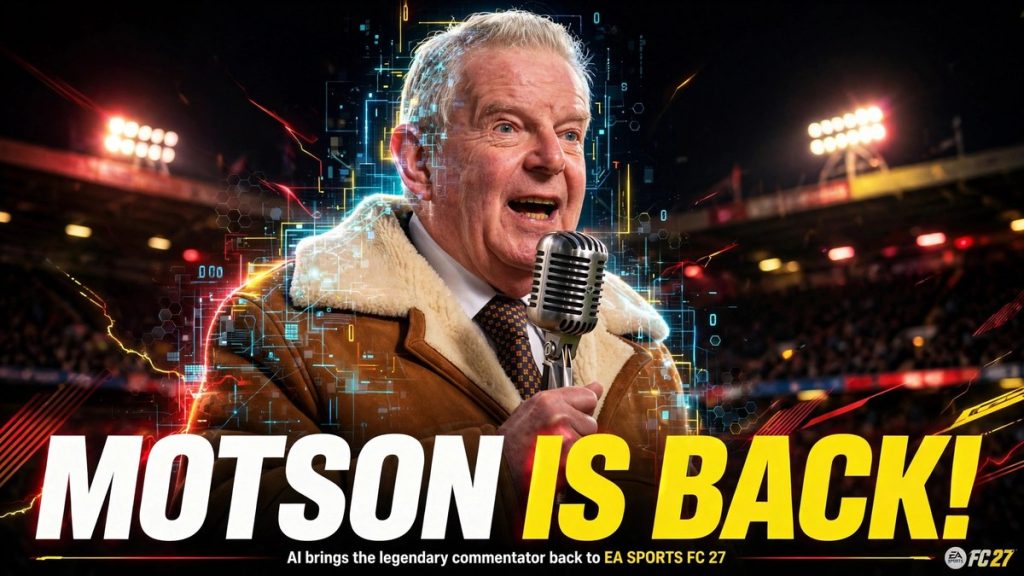
For a generation of football fans, John Motson was the sound of the game. His voice carried the drama of cup finals and relegation battles, first on the BBC and then, from 1996, inside EA’s football video games. Motson died in February 2023 at the age of 77. Three years later, his voice is back — recreated with artificial intelligence, and available to players of EA Sports FC 27.
EA announced the return as a digital tribute, built on almost ten years of Motson’s in-game recordings and completed with new AI tools. The result mixes his original audio with an AI recreation trained on recordings of the man himself, allowing him to commentate on players and moments that did not exist when he last stepped into a recording booth. The feature arrived in the game’s Title Update v1.3.0 on 26 November 2026, as an optional commentary choice alongside the existing broadcast teams.
It is the first time the series has featured a commentator who has died, and it has reopened a debate that runs far beyond football games: when is it right to bring a dead person’s voice back to life with AI, and whose permission is enough?
AI John Motson FC 27: How the Voice Was Rebuilt
Motson was the commentator on FIFA 96, the first game in the series to include commentary, and he remained in place until FIFA 06, when he was replaced by Clive Tyldesley. His decade in the commentary box made him the voice of a generation of players, and his tone was familiar to anyone who grew up watching football on the BBC, where he worked for nearly half a century. He was also famous for his sheepskin coat, which is now held by the National Football Museum as an item of significant importance to English football history.
Rebuilding that voice took more than old tapes. EA’s development studio started with almost ten years of Motson’s in-game recordings, then used generative AI tools to extend them. The archive contains the lines he recorded in the 1990s and 2000s, but it does not contain him saying the names of modern players — Paris Saint-Germain winger Bradley Barcola and England forward Chloe Kelly were the examples given by senior game design director Mat Prior. The AI model, trained on Motson’s own recordings, generates the new lines to cover everything that has changed in football since he last recorded.
In EA’s own words: “Building on almost ten years of in-game recordings, the EA Sports FC development studio has put Motson back into the commentary box with the aid of new AI tools, bringing a mix of both his original audio and an AI recreation trained by recordings of the man himself.”
The feature is deliberately limited. Motson is not part of the default broadcast team, and players who never open the audio settings will never hear him. Once the game has installed Title Update v1.3.0, he appears as an extra choice among the English commentary options on PlayStation, Xbox, PC and Nintendo Switch 2. Pick him and he calls your matches; pick one of the regular teams again and he is gone. There is no separate download or purchase.
The Family Said Yes — and EA Paid for the Rights
None of this happened without the family’s agreement. EA approached Motson’s widow and his son, Fred, for permission to recreate his voice and use his likeness, and both agreed. EA paid the family for the rights to use his likeness and voice, although the company has not disclosed the financial terms.
Mat Prior, EA Sports FC’s senior game design director, told the BBC that getting the family’s permission was imperative. “There was no way we would have moved forward with this in any way, shape or form if they weren’t fully on board,” he said.
Fred Motson said he believed his father would have approved of the idea. In EA’s official statement, the company said: “We’re honoured to bring back the iconic voice of John Motson, the legendary English football commentator and unmistakable voice of a decade of EA Sports football titles from 1996 to 2006. With the blessing and partnership of Motson’s family, EA Sports FC have worked with extensive care and respect to create a digital tribute to one of the game’s greatest voices, inspiring a whole new generation of football fans.”
Current commentators have welcomed the move. Derek Rae, one of the commentators working on EA Sports FC 27, said he was excited by the inclusion of Motson’s voice and did not believe AI was going to replace his own work on the game.
A First for the Series — But Not for Sports Games
Motson is the first late commentator to appear in the football series, but EA has already used similar technology elsewhere. In NHL 27, the commentator John Buccigross has said that an AI version of his own voice is used for some lines — and he is fine with it, because it means less work for him. The difference is that Buccigross is alive and agreed to the use of his own voice himself.
That difference is at the heart of the debate. AI voice recreation has become a standard tool in games and broadcasting: it can fill gaps in a recording, update old lines, and keep a familiar voice in use long after the sessions ended. What it had not done in this series before was recreate the voice of someone who can no longer consent.
EA has been careful to frame the Motson feature as a tribute rather than a replacement. Prior has stressed that the company has no plans to start replacing living commentators with AI. “It’s not there to replace commentators in any way, shape or form,” he said. “There’s certainly no future plans to replace anyone with AI.”
The distinction matters to the people whose voices are at stake. A recreation of a dead commentator, approved by his family and clearly labelled as a tribute, is one thing. A system that quietly replaces working commentators with cheaper synthetic voices is another. EA’s position is that the Motson feature is firmly the first of those, and that the line will hold.
The Objection: Family Consent Is Not the Same as His Consent
Not everyone is convinced. Peter Caulfield, founder of Save Our Voices Now, a campaign group against AI voice cloning, said he would have had no issue if Motson himself had signed a deal allowing his voice to be recreated. The problem, in his view, is that Motson never did — and a family’s approval after death is not the same as the person’s own choice while alive.
It is an argument that reaches beyond one football game. As AI voice technology improves, the question of who can authorise the use of a dead person’s voice is becoming urgent. Actors, musicians, broadcasters and politicians all leave behind hours of recorded speech that a model can learn from. Their families may welcome a tribute, or they may welcome the money, but neither of those answers the question of what the person themselves would have wanted.
The law, in most countries, has not caught up. Rights over a person’s voice and likeness after death vary widely, and in many places they are unclear or non-existent. That leaves the decision to companies and families, negotiating case by case, with no consistent rules about consent, payment or the limits of what can be done with a recreated voice.
For players, the reaction has been mixed. Many have welcomed the return of a voice tied to their childhoods, calling the tribute touching and long overdue. Others have called it unsettling, arguing that a dead commentator should be remembered rather than simulated. The split mirrors the wider public mood on AI recreations: delight at hearing a familiar voice again, discomfort at the knowledge that the person behind it is gone.
What This Means for Games and Broadcasting
Whatever the debate, the Motson feature sets a precedent. EA is the biggest sports game publisher in the world, and its decision to recreate a dead commentator with family permission and payment will be watched by every other studio considering the same thing. If players embrace the feature, more tributes will follow. If they reject it, the industry will think twice.
The technology itself will only get better. Models trained on a person’s recordings can already generate new lines that sound convincingly like the original, and the gap is closing fast. The Motson recreation still mixes old recordings with new AI lines, partly because the archive is so large, but future versions may need less and less original material.
That is why the rules around consent matter now, while the technology is still new enough to shape. The Motson case shows one way of doing it: family permission, payment, a clear label as a tribute, and an opt-in setting that no player is forced to use. Whether that becomes the standard, or merely the first example, will depend on what the industry and its audiences decide in the months ahead.
For now, players who choose him will hear a voice they thought they had lost for good, calling goals by players Motson never saw. His son believes he would have approved. His family has been paid. And the game that made him the voice of a generation has brought him back — with AI, and with the blessing of the people who knew him best.
Frequently Asked Questions
Who was John Motson?
John Motson was a legendary English football commentator who worked for the BBC for nearly 50 years and voiced EA’s FIFA games from FIFA 96 to FIFA 06. He died in February 2023 at the age of 77.
How does the AI John Motson work in FC 27?
EA combined almost ten years of Motson’s original in-game recordings with a generative AI model trained on his voice, allowing him to commentate on modern players and moments he never recorded.
Did Motson’s family agree to the recreation?
Yes. EA approached his widow and his son Fred, both agreed, and EA paid the family for the rights to use his likeness and voice. The financial terms were not disclosed.
How do players turn on the Motson commentary?
After installing Title Update v1.3.0 on 26 November 2026, players can select the Motson tribute as an optional English commentary choice in the game’s audio settings. It is not the default.
Why is the feature controversial?
Campaigners argue that family approval after death is not the same as the person’s own consent. Peter Caulfield of Save Our Voices Now said he would have had no issue if Motson himself had signed a deal allowing it.