Were the Oldest Cave Paintings Created by Our Mysterious Cousins?
Were the Oldest Cave Paintings Created by Our Mysterious Cousins?
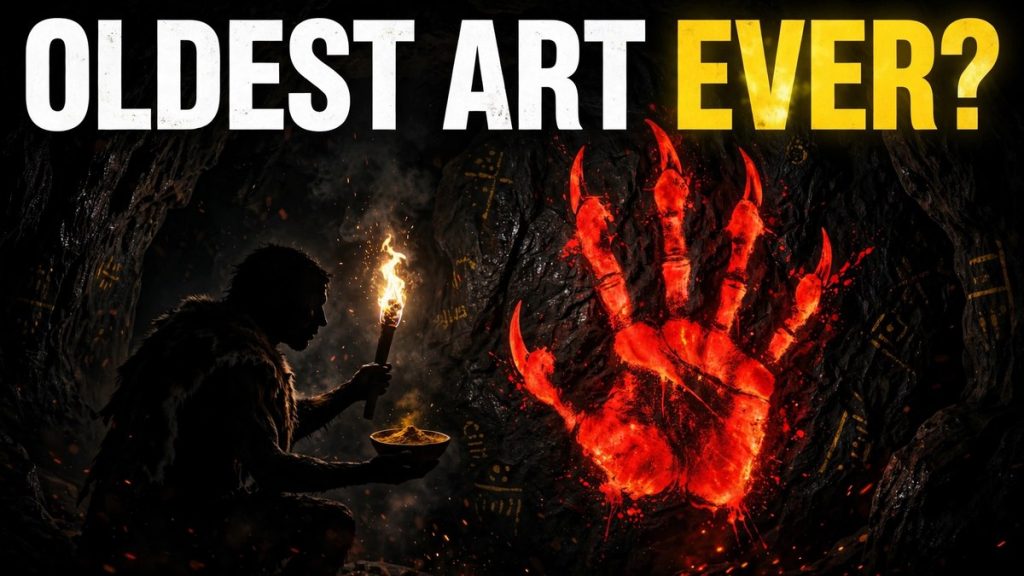
On a cave wall on a small Indonesian island, a faint outline of a human hand has waited for nearly 68,000 years. The hand was stencilled in red pigment, then altered so that its fingers narrowed into a claw-like shape, a deliberate act of imagination by someone who lived when mammoths still walked the Earth. Scientists have now dated the image to at least 67,800 years ago, making it the oldest known cave art in the world. The discovery has reopened a question that reaches to the roots of human creativity: who made it? The answer may be our own species, Homo sapiens. Or it may be one of our mysterious cousins, the Denisovans, an extinct human relative known mostly from DNA.
The stencil was found in Liang Metanduno, a limestone cave on Muna Island, just off the southeastern coast of Sulawesi in Indonesia. An international team led by researchers from Griffith University in Australia, Southern Cross University, and Indonesia’s National Research and Innovation Agency, known as BRIN, dated the artwork using an advanced laser technique and published the result in the journal Nature in January 2026. The finding pushed the record for the world’s oldest cave art back by thousands of years and suggested that the first people to reach Australia did so far earlier than many archaeologists had thought.
The Oldest Cave Paintings: A Handprint at Least 67,800 Years Old
The stencil itself is barely visible. It survives as a fragmentary outline on a cave wall surrounded by paintings of much more recent origin, some of them thousands of years younger. The artist pressed a hand against the rock and blew or spat pigment over it, leaving a negative image. Then the hand was reworked, the outlines of the fingers deliberately narrowed to create the impression of a claw. That second step is what makes the find remarkable. It shows that the maker was not simply recording a hand. The image was altered for effect, a sign of symbolic thinking.
Dating the stencil required a new method. The team used laser-ablation uranium-series dating, a technique that measures microscopic layers of calcite, a mineral that formed over the pigment like a thin skin of stone. By dating the calcite, the researchers could set a minimum age for the art beneath it. The calcite above the Muna hand stencil gave a date of 71,600 years, plus or minus 3,800 years, which means the painting underneath must be at least 67,800 years old.
The technique was developed in 2021 by Renaud Joannes-Boyau, director of higher degree research training at Southern Cross University, who led the dating work. Earlier methods averaged the age of several mineral layers at once, which could make artworks appear younger than they were. The laser method isolates the oldest layer, giving a more accurate minimum age.
The Muna stencil is about 1,100 years older than the previous record holder, a hand stencil in Spain attributed to Neanderthals. That Spanish date is itself contested, and some experts doubt it. The Muna result is also 16,600 years older than the previous oldest art from Sulawesi, a scene of human-like figures interacting with a wild pig at Leang Karampuang, dated to at least 51,200 years ago and published in Nature in July 2024.
Who Made the Art? Homo Sapiens or Denisovans?
The identity of the artist is the question that gives the discovery its edge. The research team believes the artwork was most likely made by Homo sapiens, but the scientists cannot say this for certain. The region where the art was found lay within the range of several ancient human populations during the Late Pleistocene, including early modern humans migrating out of Africa and archaic groups such as the Denisovans.
Denisovans are among the most elusive of our extinct relatives. They were identified only in 2010, from DNA extracted from a finger bone found in Denisova Cave in Siberia. Since then, only a handful of fragmentary remains have been attributed to them, including a jawbone found in Taiwan. Yet their DNA survives in present-day people, especially those with ancestry from East Asia, Melanesia, and Oceania. Some people in Papua New Guinea carry up to 5 percent Denisovan DNA, evidence that modern humans and Denisovans met and had children together.
The Muna handprint sits in exactly the kind of place where those meetings could have happened. The island of Sulawesi lies on the route between Asia and Sahul, the ancient landmass that joined Australia and New Guinea when sea levels were lower. Genetic evidence shows that Denisovans were widespread across much of Asia. If they reached Sulawesi, they could have been the artists. The stencil’s claw-like fingers have even prompted speculation that the image was meant to represent something other than a human hand, though no one can say what the maker intended.
Professor Adam Brumm of Griffith University, who co-led the project, said the discovery adds to the emerging view that there was no sudden awakening of creativity in Europe. Instead, the capacity for symbolic thought was innate to our species, with evidence stretching back to Africa, where humans evolved. Maxime Aubert, an archaeologist and geochemist at Griffith who also co-led the study, said the research showed that Sulawesi was home to one of the world’s richest and longest-lasting artistic cultures, with origins in the earliest history of human occupation of the island at least 67,800 years ago.
What the Discovery Means for the Peopling of Australia
The age of the stencil carries implications far beyond art history. Its presence in Sulawesi suggests that the first peopling of Sahul, about 65,000 years ago, involved sea journeys between Borneo and Papua, a region that remains poorly explored by archaeologists. The finding strengthens the argument that Homo sapiens had reached the wider Australia-New Guinea landmass around 15,000 years earlier than some researchers had argued.
The cave at Liang Metanduno was used for making art over an exceptionally long period. The research team found that paintings were produced there repeatedly for at least 35,000 years, continuing until about 20,000 years ago. The faint 67,800-year-old stencil is the oldest layer in a long tradition, not a single isolated act. Adhi Agus Oktaviana, a rock art specialist at BRIN and a team lead, said the paintings had far-reaching implications for understanding the deep history of Australian Aboriginal culture, whose ancestors were closely linked to the population that made the Sulawesi art.
Earlier discoveries in the same region had already rewritten the timeline. In 2017, a doctoral student named Basran Burhan found a life-sized painting of a warty pig in the Leang Tedongnge cave, dated to at least 45,500 years old. That pig was for a time the oldest known representational art on Earth. The Leang Karampuang scene, with its three human-like figures and a wild pig, pushed the record to 51,200 years in 2024. Each new result has moved the date further back, and researchers expect older art may still be found.
The Oldest Art in the World Is Under Threat
The same caves that preserved the art for tens of thousands of years are now under pressure. More extreme weather, driven by climate change, is damaging rock art across South Sulawesi, where more than 500 sites have been recorded. Heat and smoke from wildfires add to the danger. In January 2026, after the announcement of the 67,800-year-old handprint, local media reported that the Indonesian government had pledged to safeguard the cave on Muna Island and name it a nationally protected site.
Indonesia submitted the Maros-Pangkep limestone landscape in South Sulawesi to UNESCO for consideration as a World Heritage Site in 2025. The landscape holds some of the densest concentrations of early rock art anywhere in the world. Shinatria Adhityatama, an archaeologist at BRIN, is among the researchers working to document the sites before more of the art is lost.
The research team also hopes to extract DNA from residual saliva left on the cave walls when the artists blew pigment over their hands. If that succeeds, it could finally settle the question of who made the oldest art in the world. Until then, the handprint on Muna Island remains an open mystery: a work of imagination made by someone whose species we cannot yet name, at a time when our own ancestors were still spreading across the planet.
Frequently Asked Questions
How old is the oldest cave painting in the world?
A hand stencil in Liang Metanduno cave on Muna Island, Indonesia, has been dated to at least 67,800 years old, based on uranium-series dating of calcite over the pigment, published in Nature in January 2026.
Who created the oldest cave paintings?
Researchers believe the Muna hand stencil was most likely made by Homo sapiens, but they cannot prove it. Denisovans, an extinct human relative, also lived in the region and remain a possible creator.
What is special about the Muna hand stencil?
After the hand was stencilled, its fingers were deliberately narrowed to create a claw-like shape, suggesting symbolic thinking rather than a simple record of a hand.
What was the previous oldest cave art?
A hand stencil in Spain attributed to Neanderthals, dated to at least 66,700 years ago, though that date is contested. In Sulawesi, the previous record was a pig scene at Leang Karampuang, at least 51,200 years old.
Why does the discovery matter for human history?
The stencil’s age suggests Homo sapiens reached Sahul, the ancient landmass of Australia and New Guinea, around 15,000 years earlier than some researchers had argued, and shows symbolic art existed far earlier than once believed.