
‘Hejira’ at 50: Joni Mitchell’s Masterpiece Still Resonates
‘Hejira’ at 50: Joni Mitchell’s Masterpiece Still Resonates
Fifty years after its release, Joni Mitchell’s Hejira remains one of the most admired albums in popular music. Released on November 21, 1976, the record marked a turning point in Mitchell’s career, trading the folk melodies of her early work for a restless, jazz-shaped sound written largely on the road. To mark the anniversary, Rolling Stone spoke with musicians and actors including Beck, Cameron Crowe, Clairo, Jamie Lee Curtis, Nigel Godrich, and Robin Pecknold about why the album still matters.
Hejira was Mitchell’s eighth studio album, released on Asylum Records and co-produced by Mitchell and Henry Lewy. It reached No. 13 on the Billboard 200 in the United States, where it was certified gold, No. 11 in the United Kingdom, where it earned a silver certification, and No. 22 in Mitchell’s native Canada. In the 2020 edition of Rolling Stone’s 500 Greatest Albums of All Time, it was ranked No. 133.
The album’s staying power is unusual. It was not Mitchell’s biggest seller, and its songs are long, unhurried, and built without choruses. Yet half a century on, artists across generations keep returning to it as a model of what a record can do when a songwriter follows her instincts instead of a formula.
Written on the Road
Mitchell wrote Hejira while travelling. The material came out of three journeys between late 1975 and the first half of 1976: a stretch of Bob Dylan’s Rolling Thunder Revue tour, her own short-lived Hissing tour in early 1976, and a cross-country drive she made alone in a white Mercedes, at times wearing a red wig in disguise and travelling under names such as Charlene Latimer and Joan Black.
“The Hejira album was written mostly while I was traveling in the car,” she told Crowe in a 1979 Rolling Stone cover story. The road gave the record its shape. Its nine songs form a travelogue of motion, distance, and departure, held together by open-tuned guitar and the fretless bass of Jaco Pastorius, whom Mitchell called the bass player of her dreams.
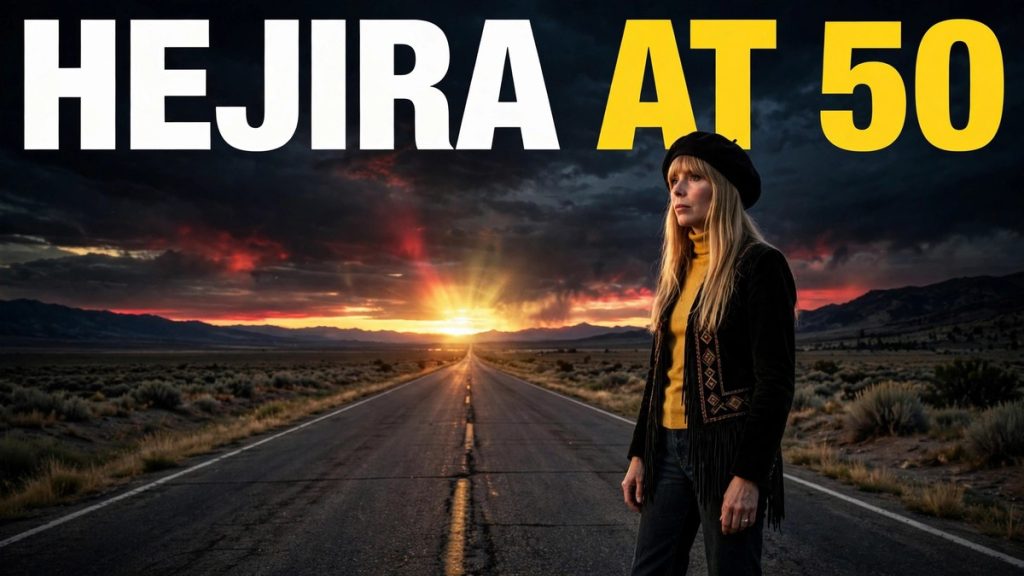
The album’s cover pointed in the same direction. Photographed by Norman Seef, it shows Mitchell in a black beret, staring at the camera as a wide, open road runs below. She wanted the image to look like an Ingmar Bergman film. Inside the gatefold, a photograph by Joel Bernstein captured her ice skating on a frozen Lake Mendota in Madison, Wisconsin, in February 1976, wearing a black ermine cape and a black wool hat. The pictures announced the record’s subject before a note was heard: a woman leaving, and not looking back.
A Word That Means Departure
The title comes from an unusual transliteration of the Arabic word more commonly rendered as Hijrah or Hegira, meaning departure or exodus. It most often refers to the migration of the Prophet Muhammad and his companions from Mecca to Medina in 622. Mitchell chose the word because it said exactly what she wanted. “Running away, honorably,” she explained.
That sense of honourable departure runs through the album. The songs deal with breakups, restlessness, and the cost of a life spent moving, but they refuse simple blame. The record is a breakup album that will not settle for easy villains, and a travel album that never quite arrives at a destination.
The Songs
Hejira opens with “Coyote”, a five-minute account of a one-night stand with a ladies’ man widely understood to be the playwright and actor Sam Shepard, whom Mitchell met on the Rolling Thunder tour. The song was also released separately as the album’s only single, in January 1977.
“Amelia”, named after the aviator Amelia Earhart, is Mitchell’s reflection on the cost of a life devoted to a calling, written from one solo pilot to another. The title track, “Hejira”, deals with her reasons for leaving the drummer John Guerin, and Mitchell described it as probably the toughest song on the album to write. Side two begins with “Song for Sharon”, at eight minutes and 40 seconds the longest track on the record.
Across all nine songs, Mitchell pared percussion back to the faintest patter, dropped choruses, and built tone poems from her guitar, mostly electric on these recordings, and Pastorius’s fretless bass. Guitarist Larry Carlton and percussionist Bobbye Hall were among the other musicians on the sessions. The result was a sound that felt like jazz without losing the songwriter’s voice, and it opened a more experimental period that would lead to 1977’s Don Juan’s Reckless Daughter and 1979’s Mingus.
Reception Then and Now
When Hejira appeared, it divided opinion. Some listeners missed the melodies of Blue and Ladies of the Canyon, and the album sold less than its predecessors. It still secured gold certification in the United States by December 1976, representing 500,000 certified units, and its reputation has only grown since.
Critics now describe the record as arguably Mitchell’s most cohesive body of work, and many call it her greatest album. Its influence shows up in the artists who lined up to honour it at 50. Beck, Clairo, and Fleet Foxes’ Robin Pecknold are among the musicians who have spoken about its pull, while Cameron Crowe, who first discussed the record with Mitchell in 1979, is now working on a biopic of the singer, bringing the story full circle.
The anniversary also arrives in a year when Mitchell herself remains active in public life. She turned 83 on November 7, 2026, and the celebrations around Hejira have included tributes, live performances of the album’s songs, and new writing about a record that many listeners first discovered decades after its release.
Why It Endures
Hejira endures because it does not resolve its tensions. It is a record about leaving that never pretends leaving is simple, and about freedom that never pretends freedom is free. Mitchell’s lyrics examine the apparent incompatibility of love and work, belonging and motion, with a directness that still feels startling.
The album also rewards the kind of listening it asks for. It was made for headphones, without distraction, and for listeners willing to follow nine long songs through their full arc. In an era of short attention and shorter songs, that demand looks less like a limitation and more like a statement of intent.
Fifty years on, Hejira sounds like motion, memory, and the long road home. It is the sound of an artist who got in her car and drove, and who turned the drive into one of the defining records of her career.
Frequently Asked Questions
When was Joni Mitchell’s Hejira released?
Hejira was released on November 21, 1976, on Asylum Records. It was Mitchell’s eighth studio album.
How did Hejira perform on the charts?
The album reached No. 13 on the Billboard 200 in the United States, No. 11 in the United Kingdom, and No. 22 in Canada. It was certified gold in the United States and silver in the United Kingdom.
Who played on Hejira?
The album features Jaco Pastorius on fretless bass, guitarist Larry Carlton, and percussionist Bobbye Hall, among others. Mitchell co-produced the record with Henry Lewy.
What does the title Hejira mean?
It is a transliteration of the Arabic word Hijrah, meaning departure or exodus. Mitchell chose it because it captured the album’s theme of leaving, which she described as “running away, honorably.”
Which artists honoured Hejira at its 50th anniversary?
Rolling Stone spoke with Beck, Cameron Crowe, Clairo, Jamie Lee Curtis, Nigel Godrich, and Robin Pecknold about the album’s legacy for the anniversary.