China Tests Makeshift Floating Bridges in Amphibious Landing Drills Near Taiwan
China Tests Makeshift Floating Bridges in Amphibious Landing Drills Near Taiwan
China is staging a weeks-long amphibious landing drill in the province facing Taiwan, testing a new method to land troops ashore by linking civilian vessels into a makeshift floating bridge, according to satellite images and a research report reviewed by Reuters. The exercise, in Dacheng Bay in China’s southeastern province of Fujian, was first spotted on November 1, 2026, and was still in progress on Friday, November 27.
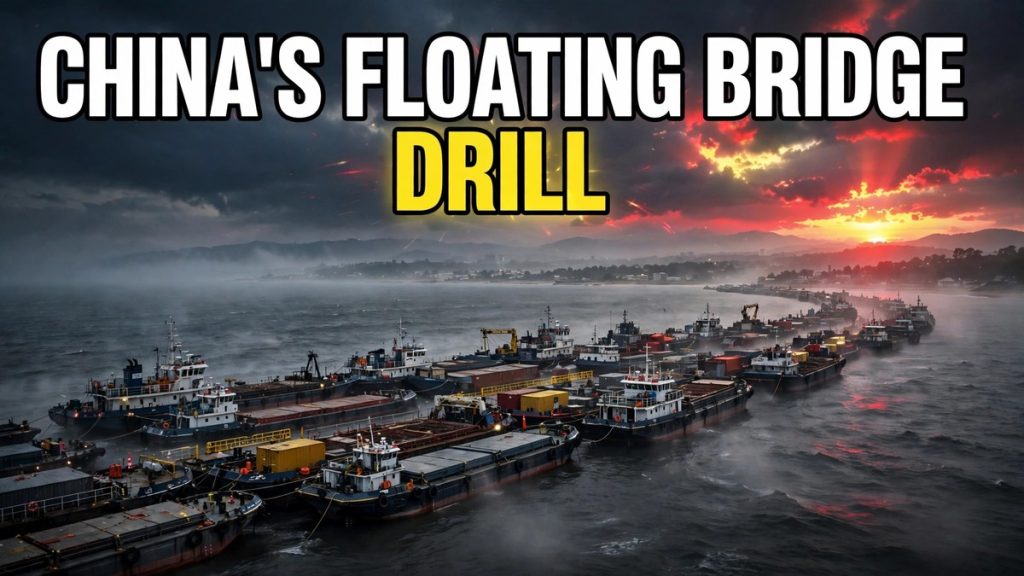
The drill is taking place about 280 kilometres (175 miles) from Taiwan’s main island, near Dongshan Island. Analysis of satellite images from November 1 to 16 showed vessels manoeuvring around the bay, forming and dismantling a floating bridge about 800 metres (2,600 feet) long, in activity also seen in images from commercial providers Vantor and Planet Labs.
The findings come from geospatial data company ingeniSPACE, whose report and tracking data were reviewed by Reuters. A senior security official briefed on the drill confirmed it was still under way on Friday, but made no direct link to local elections set for the next day.
Eight Civilian Vessels and a Floating Bridge
Eight civilian vessels took part in the exercise, made up of four barges, two semi-submersible vessels, and two powered vessels, along with four landing craft, smaller support vessels, and Chinese navy ships nearby, according to ingeniSPACE’s analysis and tracking data.
No purpose-built bridging equipment was observed, suggesting China’s military may be honing its use of existing civilian maritime resources to improvise landing infrastructure in a combat scenario, the company said. The vessels repeatedly formed the bridge and then dismantled it, a pattern consistent with rehearsal rather than a one-off test.
Jamming activity was also observed in the area where the drill was held, ingeniSPACE’s chief operating officer Jason Wang said, citing a blurry synthetic aperture radar image obtained by the company.
Why the Drill Matters
The exercise appears designed to solve one of the hardest problems in any amphibious landing: getting heavy equipment and supplies from ships in deeper water onto a shore that may lack a suitable port. A floating bridge built from civilian vessels would let forces move tanks, trucks, and materiel across open water to points along a coastline that an attacker could not otherwise reach.
“The People’s Liberation Army appeared to be rehearsing low-signature methods to provide logistical support to forces that could be involved in a first island chain invasion scenario,” Wang said. “Using civilian ships to enable bridging of heavy equipment and materiel from deeper waters creates additional locations they can use along the Taiwan coastline.”
The first island chain is the arc of islands stretching from Japan through Taiwan and the Philippines. The senior security official briefed on the drill said it was designed to “practice the swift seizure of small islands” and was “very targeted” at contingencies along that chain.
A Routine Exercise, Held Later Than Usual
The drill appeared to be part of this year’s “All-Military Strategic Exercise” by the Chinese military, the official said, and was routine in character but held later than in previous years. The official spoke on condition of anonymity, describing the matter as a sensitive one.
The location carries its own history. The drills are being held near Dongshan Island, which Chinese President Xi Jinping visited in 2024 and which was the site of a famous Cold War-era victory for the People’s Liberation Army.
Taiwan has watched China’s military activity closely for years, and drills of this kind are tracked by governments and analysts across the region. The use of civilian ships is a particular focus, because it suggests a military learning to draw on commercial shipping as part of its planning, widening the range of vessels and landing points it could use.
What Happens Next
The drill was still in progress on Friday, November 27, according to the senior security official, and satellite monitoring of the bay continues. Analysts will be watching whether the exercise expands, how long the vessels remain in the area, and whether similar bridging activity appears at other points along China’s southeastern coast.
For now, the images from Dacheng Bay show a military rehearsing a specific skill: building a bridge out of the ships it already has, in waters close to Taiwan, and doing it again and again until the manoeuvre becomes routine.
Civilian Ships in Military Planning
One detail in the satellite analysis has drawn particular attention: no purpose-built bridging equipment was observed anywhere in the exercise. Every part of the floating bridge came from vessels that normally serve civilian purposes, from barges and semi-submersible ships to powered vessels and landing craft, with smaller support vessels and navy ships operating nearby.
That matters because it changes how analysts count the resources available for a landing. A military that can improvise a bridge from commercial shipping does not need to build and position specialised equipment in advance, and it does not need to rely on a small number of obvious landing points. The same coastline can offer many more options when ordinary ships can be linked into a crossing.
The repeated forming and dismantling of the bridge also tells its own story. The vessels did not simply assemble once and hold position. They manoeuvred around the bay over two weeks, building the bridge, taking it apart, and building it again, in a pattern that suggests crews were practising the manoeuvre until it became familiar. That kind of repetition is the difference between a capability demonstrated once and a capability a force can rely on.
The observation of jamming activity in the area adds another layer. Electronic interference around an exercise can serve many purposes, from shielding activity to rehearsing the disruption of an opponent’s sensors. The satellite company cited a blurry synthetic aperture radar image as evidence of the jamming, and the finding has become part of the wider picture analysts are building of how the drill was conducted.
Frequently Asked Questions
Where is China holding the amphibious landing drill?
The drill is taking place in Dacheng Bay in Fujian province, about 280 kilometres (175 miles) from Taiwan’s main island, near Dongshan Island. It was first spotted on November 1, 2026.
What is the floating bridge made of?
Civilian vessels were linked together to form a bridge about 800 metres (2,600 feet) long. Eight civilian vessels took part, including four barges, two semi-submersible vessels, and two powered vessels, along with four landing craft and support vessels.
How was the drill discovered?
Satellite images and a report by geospatial data company ingeniSPACE, reviewed by Reuters, showed the vessels forming and dismantling the bridge between November 1 and 16. The activity was also visible in images from commercial providers Vantor and Planet Labs.
Why does the drill matter for Taiwan?
According to ingeniSPACE’s Jason Wang, using civilian ships to bridge heavy equipment from deeper waters creates additional locations along the Taiwan coastline where forces could land, including places without a suitable port.
Is the drill part of a larger exercise?
A senior security official said it appeared to be part of this year’s “All-Military Strategic Exercise” by the Chinese military, describing it as routine but held later than in previous years.