Wingless Flying Car From China Completes First Flight in Changsha
Wingless Flying Car From China Completes First Flight in Changsha
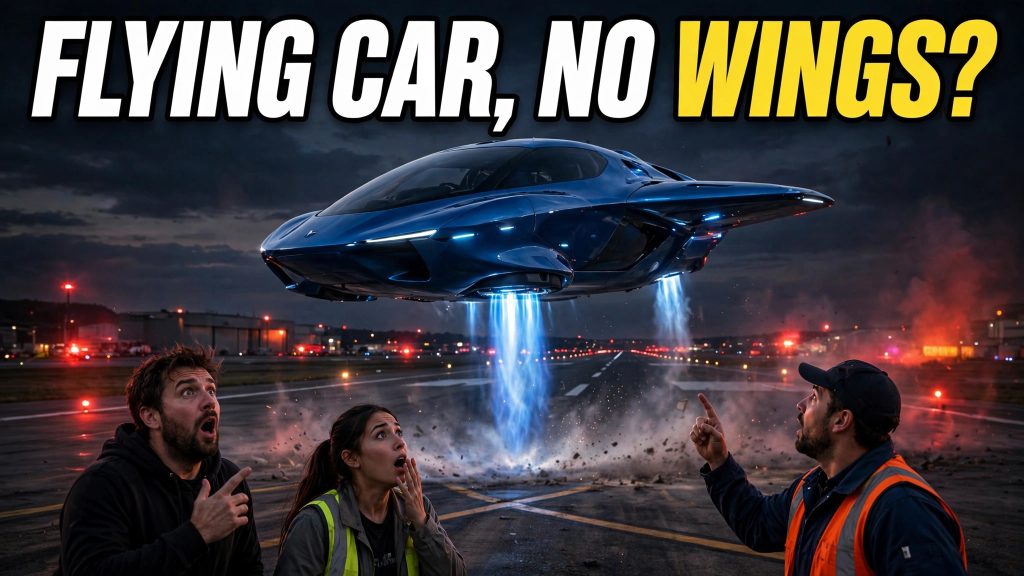
A wingless flying car China developers built in Shenzhen rose straight off the ground in Changsha on Saturday, November 21, 2026, hovered, changed position, and landed again without a runway, wings, or any propeller visible from the outside. The single-seat prototype lifted from Kaihui General Aviation Airport in Hunan province in a short demonstration that was operated by remote control, and the footage released after the flight showed the vehicle climbing almost immediately after startup. The developer, Zhongfei Chuangzhi Manufacturing (Shenzhen) Co., Ltd., said the same vehicle can drive on ordinary roads after it lands, a claim that sets it apart from most flying-car designs that still need a runway or a separate road vehicle.
The flight lasted only a short time, and the company did not publish the distance flown, the altitude reached, or whether a person was on board. The seat appeared empty in the released footage, and no report confirmed a crewed flight. That gap matters, because the published speed, range, and altitude figures are design specifications from the company rather than results measured during the demonstration. Readers should treat the performance numbers in this report as the developer stated them, not as values proved in the air on November 21.
The following day, the prototype was taken to a civil uncrewed aircraft test base in Yiyang, also in Hunan, for tests across several scenarios. Reports from the second day described simulated urban flight and flying in poor weather, along with other checks the company did not describe in full. The two-day sequence suggests the Changsha flight was the start of a longer test program rather than a finished product launch.
How the Wingless Flying Car China Built Actually Flies
The vehicle has no wings and no exposed rotor blades. Fans sit inside ducts in its body and push air downward to lift it, and the direction of that thrust can be changed to control how the aircraft tilts and moves. Zhongfei stacks three fan stages inside each duct, a design that allows the system to increase thrust without enlarging the duct area. The company describes the setup as a multistage vector ducted fan propulsion system and says its prototype is the first piloted aircraft design to use that particular arrangement.
Enclosed fans change the safety picture for a vehicle meant to fly low over streets. Exposed rotors can strike people, buildings, or other objects, and they create a clear hazard during takeoff and landing in crowded places. Housing the fans inside the body removes that exposed edge, and the company also claims the arrangement reduces noise and improves energy efficiency when compared with traditional multi-rotor designs. Those claims have not been tested in public by an independent body, and the short demonstration did not provide data to confirm them.
Power comes from a fuel-electric hybrid system, according to published descriptions of the design. The combination is intended to give the vehicle more endurance than a battery-only system of the same weight, although the company has not published a detailed breakdown of fuel use, battery capacity, or how the two sources share the load during takeoff, cruise, and landing. Takeoff and hovering demand the most power, so the hybrid layout will face its hardest test in those phases rather than in level flight.
The vehicle drives on roads after landing, which means it must meet two very different sets of demands. In the air it needs light weight and lift, while on the road it needs wheels, steering, suspension, and protection for its fans and ducts. The published design tries to solve that problem by keeping the propulsion system inside the body, so the road mode does not leave rotors or wings exposed to traffic. No public test has yet shown the transition from flight to road driving in normal traffic.
The Numbers Behind the Prototype
The single-seat prototype has a maximum takeoff weight of 280 kilograms, including a payload of up to 120 kilograms for a rider and cargo. That weight limit shapes everything else about the design, from the size of the fans to the amount of fuel and battery the vehicle can carry. A heavier rider, more cargo, or extra equipment would leave less margin for the rest of the system.
Published figures list a top flight speed of 150 kilometers per hour, while some reports give a second figure of 180 kilometers per hour. The difference appears to come from different design documents, and the company has not explained which figure applies to the prototype that flew in Changsha. The top speed on the ground is 80 kilometers per hour, or about 50 miles per hour, which puts the road mode in the range of ordinary urban traffic rather than highway travel.
The stated flight range is 300 kilometers, or about 186 miles, with a flight time of about 2.5 hours per flight according to some published descriptions. The designed maximum altitude is 3,000 meters, while the typical operating altitude is about 100 meters. Low-altitude flight at around 100 meters fits the kind of work the company has in mind, such as moving supplies or people over short distances in cities and mountain areas, rather than long flights at high altitude.
| Specification | Published figure |
|---|---|
| Seats | 1 |
| Maximum takeoff weight | 280 kilograms |
| Payload | 120 kilograms |
| Top flight speed | 150 kilometers per hour (some reports give 180) |
| Top road speed | 80 kilometers per hour |
| Flight range | 300 kilometers |
| Maximum altitude | 3,000 meters |
| Typical operating altitude | About 100 meters |
Those numbers describe what the design is intended to do, not what the November demonstration proved. The airport test was short, and the company did not release flight logs, altitude traces, or distance data from the flight. A longer test program will need to show whether the prototype can sustain its stated speed and range with a full payload, and whether it can do so in wind, rain, and heat.
Why Emergency Services Come First
Zhongfei has said the first customers are expected to be firefighting, emergency response, and disaster relief services. Project lead Shen Guanqing has pointed to uses such as getting emergency supplies into mountain communities, helping with medical transport, and supporting firefighting and rescue crews. Technical director Yang Yang has described the same focus, and reports from the test program say the vehicle is entering a pre-production trial phase with those users in mind.
Emergency work explains why a single-seat vehicle with a 120-kilogram payload can still be useful. A fire crew does not need a flying taxi for five passengers. It needs a machine that can reach a remote slope, a flooded road, or a building cut off from ground access, deliver a small load, and return. A vehicle that can land on a road, drive to a loading point, and take off again fits that pattern better than a helicopter that needs a clear landing zone and a separate ground vehicle.
The Yiyang tests included simulated urban flight and poor weather, two conditions that emergency crews face in real work. A vehicle that only flies in calm, clear conditions would be of limited use to a rescue team. The company has not published the results of those scenario tests in detail, so it is not possible to judge how the prototype performed when the weather turned or when buildings and other obstacles were close by.
Price has not been announced, and the vehicle is not available to the public. Reports from the test program say a regular member of the public cannot buy the car at present, and early use may be limited to official government services. That limit is common for a new aircraft type, which must pass certification and prove its safety record before it can be sold to private buyers.
A Decade of Development Behind One Short Flight
The brief flight in Changsha followed a development process that began more than a decade ago and changed shape several times. The aircraft that flew in November is the fourth complete iteration of the design, and it is described as an initial version intended to lead toward production. Earlier versions were smaller tests, and the current vehicle reflects lessons from those tests rather than a sudden breakthrough.
Between 10 and 20 prototypes of different types are scheduled for testing at a pilot base in Changsha. The program has moved beyond initial small tests into verification with small batches, including stability and adaptability checks under different conditions. That stage matters because a single successful flight does not prove a design is ready for regular use. Repeated flights with different prototypes, in different weather, and with different loads provide the data that certification authorities will want to see.
Zhongfei plans to build the vehicle in Changsha and to pursue airworthiness certification while the test program continues. The next product dates are 2027 for a version with two to four seats and 2029 for a larger model, including a six-seat version and a heavy-duty model. The company has also drawn up a separate design with a maximum takeoff weight of 5.5 metric tons and room for up to two metric tons of payload, a scale that would move the concept from a single-seat emergency vehicle toward a larger transport aircraft.
Where This Design Fits Among Flying Cars
Most flying-car projects fall into two groups. One group builds a road vehicle with wings that fold away, which needs a runway. The other group builds a multi-rotor aircraft with exposed propellers, which cannot drive on a road. The wingless flying car China tested in Changsha tries to sit between those groups by hiding its fans inside the body and keeping the road mode intact.
That approach has a clear advantage in cities, where exposed rotors are a safety problem and runways are scarce. It also has a clear cost. Ducted fans are heavier and more complex than open rotors of the same thrust, and the ducts themselves take up space that could otherwise carry fuel, batteries, or cargo. The 280-kilogram takeoff weight shows how tight that trade-off is. Every kilogram spent on ducts and road hardware is a kilogram that cannot be spent on payload or range.
Other companies are working on the same problem from different directions. One day after the Changsha flight, Xpeng Aeroht announced that its A868 aircraft with six seats had completed a tilt transition test. That vehicle uses a different propulsion layout and targets a larger passenger load, which shows that the flying-car field is not settling on a single design. The Zhongfei prototype is smaller, lighter, and aimed at emergency work, while larger designs are aimed at passenger transport.
What Still Needs Proof
Several questions remain open after the November flight. The company has not published a price, a firm start date for mass production, or a customer delivery date. It has not said how many hours the prototype has flown, how it performs with a full 120-kilogram payload, or how the hybrid power system behaves during a long flight. It has also not published noise measurements, which matter for a vehicle meant to fly over cities.
Certification will be the hardest test. An aircraft that also drives on roads must satisfy aviation authorities for flight and road authorities for driving, and those two sets of rules were not written for the same vehicle. The company says it will pursue airworthiness certification, but it has not named a certification timeline or said which authority will lead the process. The test program in Changsha will need to produce the flight data that a certification review requires.
Safety in poor weather is another open question. The Yiyang tests included simulated adverse weather, but simulation is not the same as flight in rain, wind, and low visibility with a full load. Emergency crews work in exactly those conditions, so the vehicle will need to prove it can handle them before it can be trusted for rescue work. The company has not released detailed results from those tests.
What the Flight Means for Low-Altitude Transport
The Changsha flight does not mean flying cars are ready for sale, and it does not mean the wingless design has proved itself. It means a new propulsion layout has lifted a full-size prototype off the ground, hovered, moved, and landed, and that the same prototype has moved into a longer test program. That is a real step, but it is a step in a process that still has many stages to go.
For emergency services, the step matters more than it does for private buyers. A small, road-capable aircraft that can reach places a helicopter cannot land and a road vehicle cannot reach would fill a gap in rescue work. The company has chosen that gap as its first market, which is a more realistic path than trying to sell a flying car to the public before the technology is ready.
For the wider flying-car industry, the flight adds a third shape to the field. Winged road cars, open-rotor air taxis, and now a ducted-fan vehicle that drives on roads all exist as prototypes. Which shape survives will depend on certification, cost, noise, and safety, not on a single demonstration. The Changsha test gives the ducted-fan shape a place in that contest, and the next two years of testing in Hunan will show whether it can stay there.
Frequently Asked Questions
When did the wingless flying car first fly?
The prototype made its first flight on Saturday, November 21, 2026, at Kaihui General Aviation Airport in Changsha, Hunan province, China, and underwent further tests in Yiyang the next day.
Who built the wingless flying car?
It was developed by Zhongfei Chuangzhi Manufacturing (Shenzhen) Co., Ltd., a Chinese company also referred to in some reports as Zhongfei Smart Manufacturing.
How fast and how far can it fly?
The company states a top flight speed of 150 kilometers per hour, with some reports giving 180 kilometers per hour, a range of 300 kilometers, and a top road speed of 80 kilometers per hour. Those are design figures, not results measured in the short demonstration flight.
Can the public buy it?
No. No price has been announced, and the vehicle is not available to the public. Early use is expected to focus on firefighting, emergency response, and disaster relief services.
What comes next for the project?
The company plans to test 10 to 20 more prototypes in Changsha, pursue airworthiness certification, and develop a two-to-four-seat version for 2027 and a larger six-seat and heavy-duty version for 2029.