
F-22 Raptor, the World’s Most Advanced Fighter, Still Needs a 32-Year-Old Memory Card
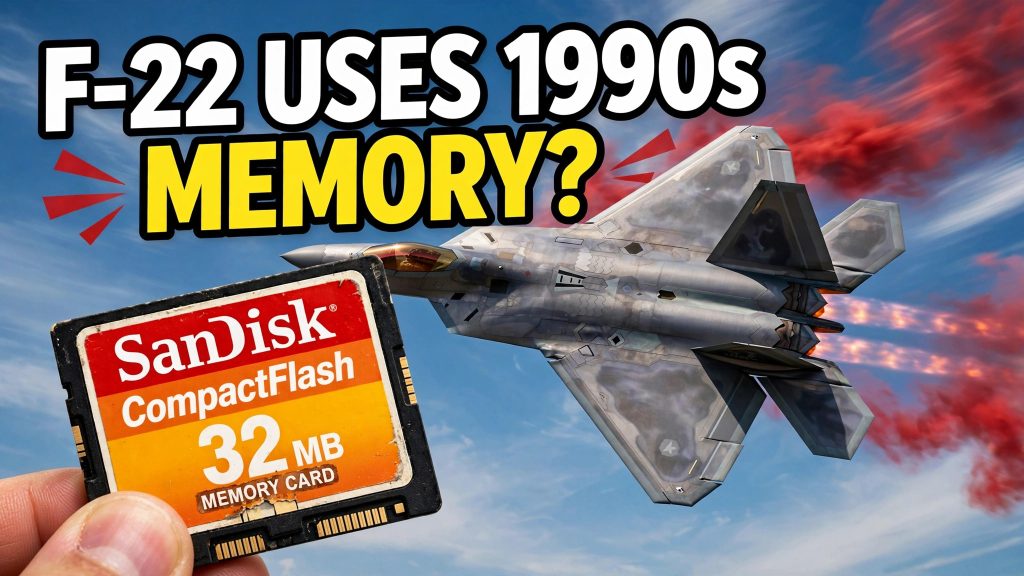
F-22 Raptor, the World’s Most Advanced Fighter, Still Needs a 32-Year-Old Memory Card
The F-22 Raptor can evade radar, fly faster than sound without afterburners, and process vast amounts of sensor data to find and engage threats. Yet the pilots who fly it still load mission information onto a removable memory card based on technology from the 1990s, and the United States Air Force is now asking American companies whether they can still supply those cards. The requirement, published on the United States government procurement portal on November 16, 2026, asks for cards with a minimum capacity of just 256 megabytes, far less storage than a modern smartphone carries.
The Air Force division responsible for the F-22 published the notice as a Sources Sought Notice, which means it is conducting market research rather than issuing a formal tender. Companies have until December 1, 2026, at 1 p.m. Eastern Standard Time, to say whether they can supply the cards. The government has said it does not presently intend to award a contract, but wants information for future planning. That careful wording matters, because the notice is a search for suppliers, not a purchase order.
The contrast between the aircraft and its memory card has drawn attention because it shows a problem that affects many advanced military systems. An aircraft designed in the 1990s must keep flying for decades, and the parts it was built with may no longer be made. The F-22 first flew in 1997 and entered service in 2005, and the last jet was delivered in 2012. The Air Force plans to operate the type into the 2030s, which means it must find parts that fit hardware designed more than 30 years ago.
What the F-22 Raptor Memory Card Actually Does
The cards are part of the F-22’s Data Transfer Cartridge, a removable storage system that moves mission information between ground systems and the aircraft. Before a mission, flight routes, radio settings, and threat data are loaded onto the cartridge at a computer on the ground. The pilot plugs the cartridge into the cockpit before takeoff, uses the information during the flight, and removes it after landing so maintainers can retrieve the flight record and check the aircraft.
That workflow sounds simple, but it depends on the card working exactly as the aircraft expects. A card that holds more data is not useful if the aircraft cannot read it, and a card that uses a newer format may not fit the slot or work with the government-furnished host system that reads and writes the cards. Compatibility is the requirement, not capacity. The Air Force notice specifies that the cards must be readable and writable using that host system, and that pre-formatting with FAT16, an older file system developed decades ago, is highly preferred.
The notice asks for two types of storage device. The first is a PC Standard 95 Type II flash card, a credit-card-sized device that slid into the side of 1990s laptops. The second is a CompactFlash card fitted with a passive CompactFlash-to-PCMCIA Type II adapter. PCMCIA, short for Personal Computer Memory Card International Association, was a standard for removable expansion and storage cards in laptops during the 1990s and early 2000s. CompactFlash was another popular format, used mainly in digital cameras before smaller formats such as SD cards became widespread.
Why 256 Megabytes Is Enough, and Why It Is Hard to Find
A minimum capacity of 256 megabytes sounds small because it is small. A modern smartphone can store that amount in a handful of photographs, and a single high-resolution image can exceed it. Mission data for a fighter, however, is mostly text, coordinates, radio frequencies, and threat tables, not video or large images. The data that a pilot needs for a mission fits in a small file, and the aircraft was designed when 256 megabytes was a reasonable size for that file.
The problem is not capacity but supply. Companies stopped making PC cards and CompactFlash cards in large numbers years ago, as laptops and cameras moved to smaller formats. The factories that made them have closed or switched to other products, and the materials and tools for those formats are no longer common. A company that wants to supply the Air Force must either find old stock, restart a production line for a small order, or prove that a new card can work in the old system without changing the aircraft.
The Air Force also wants to know where the cards were made and how suppliers guard against counterfeits. That requirement reflects a wider concern in military supply chains, where a fake part can fail at a critical moment or carry hidden flaws. Vendors must prove the origin of their cards and describe their anti-counterfeit measures, and they must say how long each card will stay on sale. The notice does not say how many cards the Air Force needs or what it expects to pay, because it is a market survey, not a purchase.
The F-22 Itself Has Not Stood Still
The reliance on 1990s storage does not mean the entire aircraft runs on outdated technology. The F-22 Raptor is a fifth-generation fighter, a category defined by stealth technology, advanced sensors, integrated avionics, and the ability to share battlefield information. It was developed by Lockheed Martin in partnership with Boeing, as a twin-engine, single-seat fighter. It made its maiden flight in 1997 and became operational in 2005, and it has never been exported, which makes it a unique asset for the United States Air Force.
The Air Force continues to modernize the aircraft through a program called Raptor Agile Capability Release, which introduces improvements to sensors, communications, data links, and survivability. The service is also testing new fuel tanks and sensors to keep the fighter in service through the 2030s. Those upgrades change the sensors and software, but they do not change the physical slot that accepts the Data Transfer Cartridge, and they do not change the need for a card that fits that slot.
That pattern is common in long-lived military aircraft. The airframe, engines, and sensors can be upgraded, but the interfaces between systems often stay the same because changing them would require redesigning the aircraft. A new memory card format would need a new reader, new software, and new testing, and that work would cost far more than finding a supplier for the old format. For a fleet that will retire in the 2030s, the cheaper path is to keep the old format working.
A Problem That Goes Beyond One Fighter
The F-22 is not the only system that faces this problem. Military aircraft, ships, and ground systems often stay in service for 30 or 40 years, while the electronics inside them change every few years. A radar, a radio, or a computer built in one decade may need parts that were last made in an earlier decade, and the companies that made those parts may no longer exist. Governments around the world keep lists of obsolete parts and search for suppliers who can still make them.
The challenge is sharpest for systems that were built in small numbers. The F-22 was produced in a limited run, and the last jet was delivered in 2012. A small fleet means a small market for spare parts, and a small market gives companies little reason to keep a production line open. The Air Force must therefore ask the market whether anyone can still supply the part, and it must do so before the existing stock runs out.
Counterfeit parts add a second layer of risk. When a part becomes scarce, fake copies appear, and a fake memory card may look identical to a real one while failing under stress. The Air Force notice asks vendors to prove where their cards were made and how they guard against counterfeits, a step that shows the service is aware of that risk. A card that fails during a mission could leave a pilot without the data needed to complete the flight safely.
What Happens After December 1
Responses to the notice are due by December 1, 2026. After that date, the Air Force will review the responses and decide whether any company can meet the requirement. If a supplier is found, the service may issue a formal request for proposals at a later date. If no supplier is found, the service may need to consider other options, such as redesigning the cartridge, adapting a newer card format, or drawing on existing stock for as long as it lasts.
The notice does not commit the government to a purchase, and it does not say how many cards would be bought if a contract were awarded. That uncertainty is normal for a Sources Sought Notice, which is a tool for gathering information before a decision is made. Companies that respond are not bidding on a contract, and the Air Force is not promising to buy from them.
The timing matters because the F-22 fleet will keep flying while the search continues. Each mission needs a working Data Transfer Cartridge, and each cartridge needs a working card. The Air Force has stock for now, but the notice shows that the service is planning ahead rather than waiting for the stock to run out. The December 1 deadline gives companies two weeks from the November 16 publication to respond, a short window that reflects the urgency of the requirement.
For readers outside the military, the story is a reminder that advanced technology does not always mean new technology. A fighter that can evade radar and fly at supersonic speed without afterburners still depends on a card format from the 1990s, because that format works with the aircraft as it was built. The F-22 will keep flying into the 2030s, and for as long as it flies, it will need a part that the rest of the world stopped making years ago.
Frequently Asked Questions
What memory cards does the F-22 Raptor use?
The Air Force is seeking PC Standard 95 Type II flash cards and CompactFlash cards with passive CompactFlash-to-PCMCIA Type II adapters, with a minimum capacity of 256 megabytes, for the aircraft’s Data Transfer Cartridge.
Why does the Air Force need such old cards?
The cards must fit the F-22’s existing hardware and work with its government-furnished host system. A newer card format may not fit the slot or work with the aircraft’s software, even if it holds far more data.
When are responses to the Air Force notice due?
Responses to the Sources Sought Notice, published on November 16, 2026, are due by 1 p.m. Eastern Standard Time on December 1, 2026.
Is the Air Force buying the cards now?
No. The notice is market research, not a purchase. The government has said it does not presently intend to award a contract, but wants information for future planning.
How long will the F-22 stay in service?
The Air Force plans to operate the F-22 into the 2030s, and it is modernizing the aircraft through the Raptor Agile Capability Release program, which upgrades sensors, communications, data links, and survivability.