
New Crab Species Found Off California Coast After Warm Waters Push Marine Life North
New Crab Species Found Off California Coast After Warm Waters Push Marine Life North
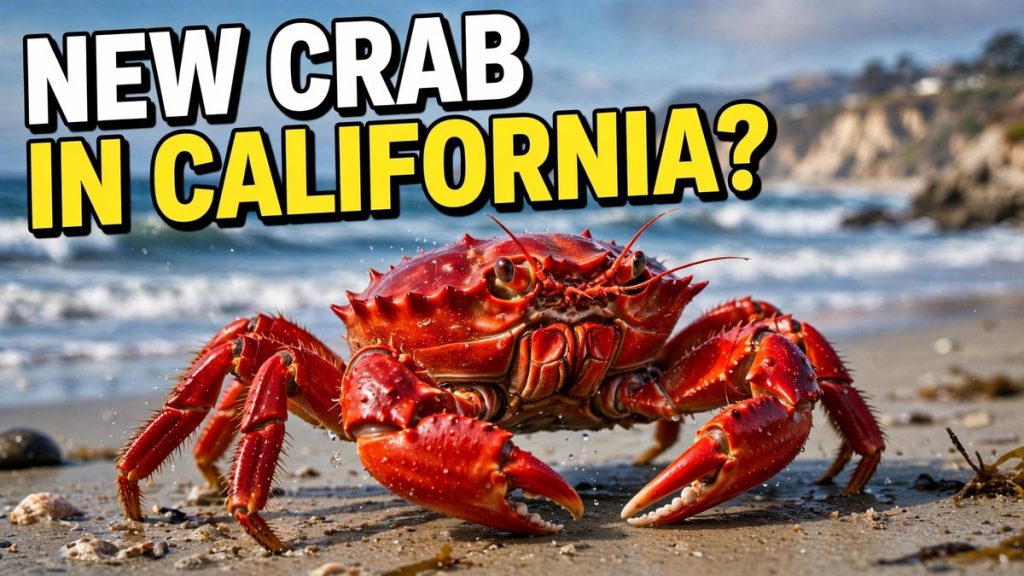
Reports of a new crab species California waters have drawn attention to the Pacific coast, where warm ocean currents have carried small red crabs far north of their usual range. The crabs, known as pelagic red crabs or tuna crabs, were reported in large numbers off California in the autumn of 2026, and researchers said juveniles of the species had been spotted in Monterey Bay for the first time.
The animals are thumb-sized, bright red, and normally found in large numbers off Baja California, in Mexico, where the water is warmer than it usually is off California. When El Nino stirs strong and unusual currents, the crabs ride along by the millions. In warm water years they have painted beaches red for miles, from San Diego to Monterey Bay, and in a record year they reached as far as Oregon.
Scientists say the arrival of the crabs is a sign of how far warm water has moved north. At the end of October 2026, the temperature in Monterey Bay had reached 64 degrees Fahrenheit, or 18.18 degrees Celsius, the highest it had been in decades and even higher than during the previous strong El Nino of 1997. That warm water brought more than crabs with it, and researchers are watching what else may follow.
What Was Found Off the California Coast
Thousands of pelagic red crabs washed ashore in the Monterey Bay National Marine Sanctuary during early October 2026. The strandings were reported by researchers and by visitors to the coast, who described beaches covered in small red animals. The crabs are not strong swimmers, so they are carried by currents rather than choosing where to go.
Researchers from the Monterey Bay Aquarium Research Institute, known as MBARI, spotted juveniles of the species in October 2026. That observation was described as a first ever observation of juveniles in the area. Juveniles are young animals, and their presence suggests that the crabs were not only carried north as adults, but that young crabs were also present in the bay.
The crabs are often called tuna crabs because tuna and other large fish feed on them. They are not true crabs in the strict sense. They are squat lobsters, a group of animals that look like small lobsters or crabs but belong to a different family. That distinction matters to scientists, because it affects how the animals are classified and how they fit into the food web.
The report of a new crab species California coast was published on 27 November 2026. The report described the find as a new crab discovery off the California coast. Scientists who study the region said the animals were a clear sign that warm water species were moving into areas where they had not been common before.
Why the Crabs Moved North
The main driver was El Nino, a climate pattern that warms the surface water of the equatorial Pacific and changes ocean currents along the west coast of North America. In November 2026, the National Oceanic and Atmospheric Administration, known as NOAA, announced that the 2026 El Nino had officially reached Super El Nino status. Super El Nino conditions were recorded in the equatorial Pacific as of 11 November 2026.
When El Nino is strong, warm water moves north along the coast, and animals that live in that warm water move with it. Pelagic red crabs are one of the most visible examples, because they travel in large numbers and they wash ashore in large numbers. Other species, including fish, jellyfish and plankton, also move north during strong El Nino events.
Water temperature is the key factor. Monterey Bay is normally cooler than the waters off Baja California. When the temperature in the bay rose to 64 degrees Fahrenheit at the end of October 2026, it created conditions that were closer to the crabs’ normal habitat. That made it possible for the crabs to survive in the bay, at least for a time.
Ocean currents also play a role. The California Current normally flows south, carrying cool water from the north. During El Nino, that pattern weakens, and warm water from the south can move north more easily. The crabs, which are poor swimmers, are carried by those currents, and they cannot easily return to their original range until the currents change again.
What Pelagic Red Crabs Are
Pelagic red crabs are small, red, and about the size of a human thumb. They live in the open ocean, rather than on the sea floor, and they swim in mid-water. Their bright red colour makes them easy to see, both in the water and on the beach. When they wash ashore in large numbers, they can cover the sand in a red layer.
The crabs are an important food source for larger animals. Tuna, seabirds, sea lions and whales feed on them when they are available in large numbers. That means a large arrival of crabs can affect the feeding behaviour of many other species, at least for a short time. It can also affect fisheries, because tuna and other fish may follow the crabs into new areas.
The crabs are not dangerous to people. They do not bite or sting, and they are not a threat to swimmers. They can be a nuisance on beaches, because large numbers of dead crabs can produce a strong smell as they decay. Local authorities in California have dealt with similar strandings in past warm water years, and they usually advise people to leave the animals alone.
Scientists distinguish between a species that is new to an area and a species that is new to science. A species that is new to an area has been described before, but has not been seen in that place. A species that is new to science has never been described before, and it needs a formal description, a scientific name and a published paper before it is accepted. The California report was about a species appearing in a new place, and researchers were careful to describe what they had actually seen.
A Separate Discovery in the South China Sea
In the same month, a different crab discovery was reported in the South China Sea. A newly described crab species, Macromedaeus putrimanubriatus, was found at depths of about 100 to 300 metres, or 330 to 980 feet. The species is closely related to an intertidal species, Macromedaeus orientalis, which lives in shallow water near the shore.
The South China Sea crab was described by a research team led by Sha Zhongli from the Institute of Oceanology of the Chinese Academy of Sciences. The findings were published in the Zoological Journal of the Linnean Society on 18 November 2026. The team said the new species suggested a relatively recent shift in one crab lineage from shallow water to deeper water.
That discovery is separate from the California report. It shows that new crab species are still being described, even in 2026, and that deep water remains poorly explored.
It also shows why scientists are careful about language. A new species description requires specimens, measurements, comparison with related species and publication in a scientific journal. A sighting of a known species in a new place is a different kind of discovery, and it is reported in a different way.
What the California Find Means for Marine Science
The arrival of pelagic red crabs off California gives scientists a chance to study how marine species respond to warming water. Researchers can track how far north the crabs travel, how long they survive, and whether they return south when the water cools. That information helps scientists understand how El Nino affects the distribution of marine life.
The find also matters for fisheries. If tuna and other fish follow the crabs north, fishing boats may need to change where they operate. If the crabs stay in the bay for a long time, they may compete with local species for food. Those effects are difficult to predict, and they depend on how long the warm water lasts.
Climate change is a background factor in the discussion. Scientists do not attribute a single El Nino event to climate change, but they do note that ocean temperatures have risen over recent decades. Warmer water makes it easier for warm water species to move north, and it makes it harder for cold water species to survive in their normal range. The California crab report is one small piece of that larger picture.
Other unusual species have also been reported off the California coast in recent weeks. Beachcombers in West Marin reported a Mexican skirt dancer, a paper-thin flatworm that normally lives in the warmer waters of the Mexican Pacific, in Tomales Bay. Ocean temperatures off the Marin County coast had reached record highs, and researchers said the flatworm was another example of a warm water species moving north.
How Scientists Confirm a New Find
When scientists report a new find, they follow a clear process. They collect specimens, photograph them, measure them and compare them with known species. They check whether the animals match a species that has already been described, or whether they have features that do not match any known species. If the animals do not match, the scientists may describe a new species, but that process takes time.
For a species that is new to an area, the process is simpler. Scientists need to confirm the identification, record the location and date, and report the observation to other researchers. The observation of juveniles in Monterey Bay was important for that reason. It showed that the crabs were not only adults carried north by chance, but that young crabs were also present.
Photographs and videos from the public also help. Visitors to the coast who photograph strandings and share the images with researchers can provide useful information about the timing and scale of an event. Scientists still need to verify the identification, but public reports can alert them to a change that they might otherwise miss.
The California crab report was based on observations by researchers and on reports from the coast. The details that were verified were the location, the timing, the water temperature and the identity of the animals as pelagic red crabs. Those details are the foundation for any further study of the event.
What Happens Next for the Crabs
The future of the crabs off California depends on the water. If El Nino weakens and the water cools, the crabs are likely to die or to be carried back south by currents. If the warm water lasts, they may survive for longer, and they may be joined by other warm water species. Past El Nino events have shown both patterns.
In 2017, a record year for pelagic red crabs, the animals reached as far as Oregon. That year, the crabs were reported over a wide area, and they affected beaches from San Diego to the north. The 2026 event has so far been centred on Monterey Bay and the central California coast, but researchers are watching for reports from further north.
Researchers will continue to monitor Monterey Bay through the winter. MBARI and other institutions have instruments in the bay that measure water temperature, currents and the presence of marine life. Those instruments will show whether the warm water persists and whether the crabs remain in the area.
For the public, the advice is simple. The crabs are not dangerous, and they are a reminder of how connected the ocean is. A change in water temperature in the equatorial Pacific can affect beaches in California, and a small red crab can tell scientists a great deal about the state of the ocean.
Frequently Asked Questions
What kind of crab was found off California?
Pelagic red crabs, also called tuna crabs, were reported in large numbers off California. They are thumb-sized, bright red, and normally live off Baja California in Mexico.
Why did the crabs move north?
Strong El Nino currents carried warm water north along the coast, and the crabs, which are poor swimmers, rode along with those currents.
Are pelagic red crabs dangerous?
No. They do not bite or sting. Large numbers washing ashore can smell as they decay, but they are not a threat to people.
Is this a species that has never been described before?
No. Pelagic red crabs are a known species. The California report was about the species appearing in large numbers in a new place, with juveniles spotted in Monterey Bay for the first time.
What does the find tell scientists?
It shows that warm water has moved far north, and it gives researchers a chance to study how marine species respond to warming oceans during a Super El Nino.
The report of a new crab species California coast is a reminder that the ocean does not respect the boundaries on a map. A small red crab from Baja California, carried north by warm currents, can end up on a beach in Monterey Bay, and its arrival can tell scientists more about the state of the Pacific than a dozen instruments alone.