Xpeng Humanoid Robots Could Do Household Chores Within Three Years
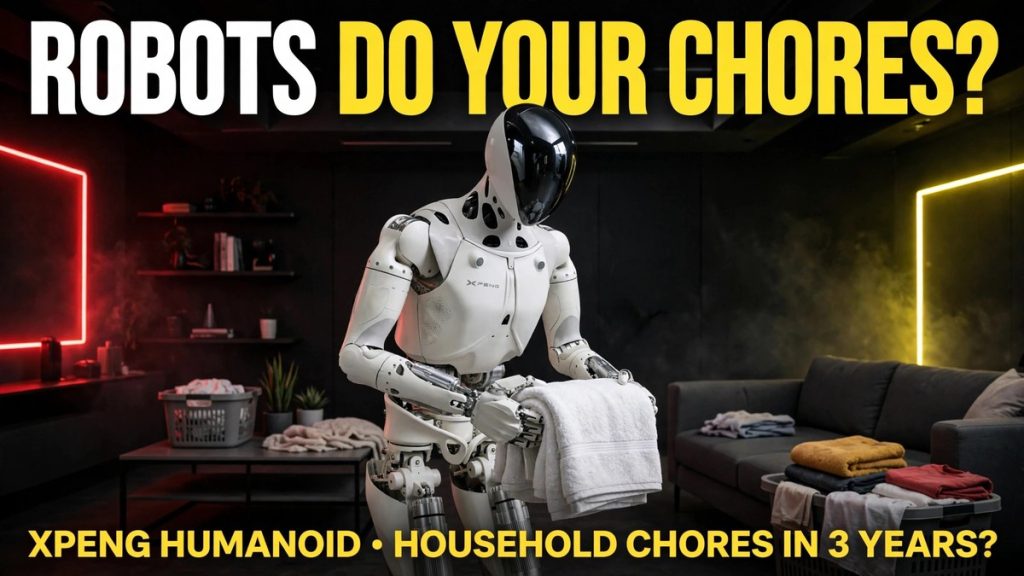
Xpeng Humanoid Robots Could Do Household Chores Within Three Years
A robot that folds laundry, tidies the kitchen, and answers questions while it works may be closer than most people expect. Brian Gu, co-president of Chinese electric vehicle maker Xpeng, said this week that humanoid robots could begin working in homes within one to two years after they prove themselves in commercial settings. The timeline puts household robots on the market far sooner than many industry watchers had predicted.
Gu made the comments after Xpeng unveiled IRON, its latest general-purpose humanoid robot, at the company’s AI Day event in Guangzhou on November 25, 2026. The robot is the centrepiece of Xpeng’s push beyond electric cars into robotics, a business Gu said could become a meaningful part of the company within two to three years.
“Maybe after successful deployment into commercial settings, maybe another one to two years, we can start thinking about deploying into home settings,” Gu told CNBC in an interview on Thursday, November 26. “Technology is moving at a much faster clip.”
From Showrooms to Living Rooms
Xpeng’s plan follows a careful sequence. The company will start mass production of IRON in January 2027. In the first quarter of next year, the robot will begin training as a store assistant in Xpeng’s own retail car locations, greeting customers and helping staff on the showroom floor. Sales are set to begin in the second quarter of 2027, with customer deliveries expected later in the year.
Only after those commercial trials will the company turn to the home. That staged approach is deliberate. A car showroom is a controlled environment with predictable tasks and trained staff nearby. A home is not. Gu said the company wants proof that IRON can work reliably for months in shops before it asks the robot to operate around families.
The schedule also reflects how fast the technology is moving. Xpeng had previously targeted selling tens of thousands of humanoid robots in 2027. The company now expects robotics to become a substantial part of its business within two to three years, with individual products possibly turning profitable as soon as next year.
What IRON Can Do
IRON is built to be a general-purpose machine rather than a single-task device. According to reports from the launch, the production robot has 76 degrees of freedom and more than 1,500 tactile sensing points, allowing it to feel pressure and grip objects with care. It runs on three in-house Turing AI chips with a combined computing power of 2,250 TOPS, and it has been trained across 250 scenarios.
The hardware is designed for real work rather than stage demonstrations. Xpeng’s engineers want a robot that can be trained for jobs in shops, warehouses, and eventually homes, without heavy customisation for each customer. Founder and chief executive He Xiaopeng told analysts on the company’s November 16 earnings call that he expects IRON to surpass the most popular premium vehicle models in sales potential and gross profit.
“We envision it as a highly standardized product for small to medium B2B customers and eventually for even individual household customers,” He said on the call.
Gu acknowledged that the hardest part of humanoid robotics is not any single movement. A robot can be programmed to talk, walk, or pick up an object. The challenge is doing all of those things at once.
“You can always make the head talk, you can always make the leg run, you can always make the hands to do certain tasks,” Gu said. “But doing a task while you’re walking and answering questions at the same time, that’s the most challenging part.”
A Price Like a Car
For the first time, Xpeng has also given a signal about what IRON will cost. Gu told Bloomberg that the robot will be priced near the median selling price of an electric vehicle. Xpeng’s cars currently list from about 119,800 yuan to about 309,800 yuan, roughly $18,000 to $54,000, which puts the first mass-market humanoid in the price band of a family sedan.
The pricing matters because it decides who can actually buy one. A robot that costs as much as a car is expensive, but it is far cheaper than the six-figure prices that early humanoids carried. Xpeng plans to sell IRON in China first, with a paid subscription and downloadable capability packages that could add new skills over time.
Investors are already paying attention. Xpeng’s robotics unit raised $900 million this summer in its first funding round, led by IDG Capital, at a valuation of $6.3 billion. Gu said he expects to add more investors after IRON’s commercial launch next year.
Why Homes Are Harder Than Shops
The gap between a showroom and a living room is wide, and Gu did not hide it. Homes require robots to act safely around elderly people, children, and pets. They must react to emergency situations, navigate cluttered rooms, and keep working for hours without recharging. Battery power and consistent performance are bigger problems at home than in a shop, where a robot can return to a charging point between tasks.
Safety is the main barrier. A robot that misjudges a grip in a shop might drop a brochure. The same mistake at home could hurt a child or an older person. Gu said household deployment will demand higher safety and performance standards than commercial settings, and the company will not rush past that line.
Still, the value of the business would rise sharply once robots enter households, Gu said. A machine that can clean, fold laundry, and help around the house would reach a far larger market than one limited to shops and warehouses. That is why Xpeng is treating the home as the second stage of its plan, not a distant dream.
Chips and Competition
Xpeng’s robotics work also benefits from the company’s existing supply chain. Gu told CNBC that the robot uses the same class of chips the company already has for driver assistance, which means it faces limited impact from United States restrictions on advanced Nvidia chip sales to China. He said he had not seen any change in supply from those restrictions.
That detail matters in a year when access to advanced chips has become a strategic question for Chinese technology companies. By building IRON around chips it already uses, Xpeng has reduced one of the biggest risks to its robotics timetable.
The competition is moving fast as well. Humanoid robots from companies in China, the United States, and elsewhere are all racing toward commercial deployment, and several have announced their own timelines for factories, warehouses, and homes. Xpeng’s advantage is that it already runs a large retail network where IRON can be tested at scale, and it already sells cars to the same customers who might one day buy a robot.
For now, the company’s message is measured. IRON will start in shops, prove itself there, and then move into homes. If that plan holds, the robot folding laundry in a living room could arrive within three years.
Frequently Asked Questions
When will Xpeng’s IRON robot be available to buy?
Xpeng plans to start mass production in January 2027, begin sales in the second quarter of 2027, and deliver to customers later in the year. Home models would follow one to two years after successful commercial deployment.
How much will the IRON robot cost?
Co-president Brian Gu said it will cost roughly the same as the median price of an electric vehicle. Xpeng’s cars range from about 119,800 yuan to about 309,800 yuan.
What will IRON do first?
IRON will be trained as a store assistant in Xpeng’s retail car locations, starting in the first quarter of 2027. Household chores such as cleaning and folding laundry are planned for a later stage.
Why are homes harder for robots than shops?
Homes require robots to operate safely around elderly people, children, and pets, react to emergencies, and maintain performance over long periods without recharging.
Will US chip restrictions affect Xpeng’s robot plans?
Gu said IRON uses the same class of chips Xpeng already has for driver assistance, and he had not seen any change in supply from the restrictions on advanced Nvidia chip sales to China.