X Launches Its First Parental Controls for Teen Accounts After 20 Years
X Launches Its First Parental Controls for Teen Accounts After 20 Years
X has finally added parental controls for teenagers, twenty years after the platform first appeared as Twitter. The new tools, announced on Wednesday, 26 November 2026, give parents and guardians a way to manage how 13-to-17-year-olds use the social network, while leaving teenagers with unusual control over the arrangement. X parental controls teens is the first time the company has built supervision directly into the platform, and the design is deliberately different from the stricter systems used by rival apps.
Teen accounts on X already default to a protected mode that restricts sensitive media and blocks targeted advertising. The new parental controls sit on top of those defaults. A parent or guardian can link their account to a teenager’s account, but only if both sides agree. The teenager keeps ownership of the account, can see every change a parent makes, and the supervision ends automatically when the teenager turns 18.
The announcement came from X’s Safety team and was confirmed by the company’s Head of Safety, Michael O’Herlihy. It arrives at a moment when lawmakers in several countries are pressing social media companies to do more to protect young users, and when every major platform now offers some form of parental supervision.
What X Parental Controls for Teens Include
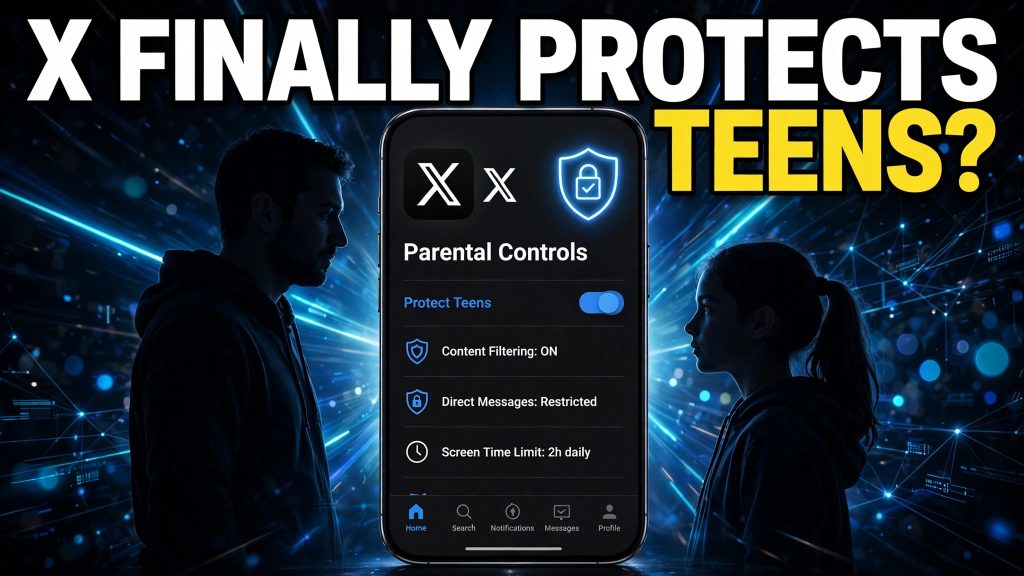
The new system gives a parent or guardian access to six areas of a teenager’s account. They can see how much time their teenager has spent on X over the past week and set a daily limit. They can require approval for new followers, which also makes the teenager’s account private. They can limit the For You feed so it only shows posts and videos from accounts the teenager already follows.
Parents can also filter specific words from their teenager’s experience and turn off sensitive media content. They can control who is allowed to send direct messages to their teenager, and they can see which accounts their teenager has chatted with one-on-one. What they cannot do is read the messages themselves.
One parent or guardian can supervise up to five teen accounts at the same time. Each teenager can be linked to only one adult at a time. The link is set up through X’s Help Center, and the process starts with the parent and finishes with the teenager.
The Six Controls Parents Can Use
X lists six supervision options. Each one addresses a different part of how a teenager uses the platform, from time spent to who can contact them.
| Control | What it does |
|---|---|
| Screen time | Shows time spent on X over the past week and allows a daily limit |
| Follower approval | Requires a parent to approve new followers and makes the account private |
| Feed limits | Restricts For You recommendations and videos to accounts the teen already follows |
| Word and media filters | Filters specific words and turns off sensitive media content |
| Direct message controls | Controls who can send the teen direct messages |
| Chat visibility | Shows which accounts the teen has chatted with one-on-one, without message contents |
The screen time tool is the most straightforward of the six. Parents see a weekly figure for their teenager’s use of X and can set a daily cap. The follower approval tool has a wider effect than its name suggests, because requiring approval for new followers also turns the teenager’s account private, limiting who can see their posts.
The feed limit changes the core of the X experience. The For You feed is driven by recommendations, and it is where a teenager is most likely to encounter posts from strangers. Restricting it to accounts the teenager already follows turns the feed into something closer to a chronological list of chosen contacts.
Word filtering lets a parent block specific terms from the teenager’s experience. Combined with the option to turn off sensitive media, it gives families a way to shape what appears on screen without removing the teenager from the platform entirely.
What Parents Cannot See or Do
The limits on parental access are as important as the controls themselves. Parents and guardians cannot read their teenager’s private messages. They cannot see search history or viewing history. They cannot post as their teenager, and they cannot access the account itself.
Every change a parent makes is recorded and visible to the teenager. That transparency is built into the design. A teenager who is linked to a parent can see exactly what restrictions have been placed on the account and when they were made.
X has presented this as a deliberate choice. In its announcement, the company said parents want practical tools and teenagers deserve room to grow. Michael O’Herlihy, Head of Safety at X, said families should be able to set the guardrails that fit their home, while teenagers keep ownership of their accounts and can see every change.
Mridul Singhai, a product engineering lead at X, described the arrangement in similar terms. He said supervision on X starts with a handshake and ends automatically when a teenager becomes an adult. The phrase captures the two features that set the system apart from most rivals: consent is required from both sides, and the supervision has a fixed end date.
Why X Waited 20 Years
X, formerly known as Twitter, launched in 2006. For almost its entire history it offered no parental controls at all, even as other major platforms built supervision tools for younger users. The gap became harder to defend as regulators in the United States, the United Kingdom and the European Union increased pressure on social media companies over child safety.
The company has long argued that X is not designed for children. Its own statement repeats that position, saying the platform is not designed for or promoted to children, and that users must be at least 13 years old, or older where required by law. Teen accounts were already set to protected mode by default before this announcement, with sensitive media restricted and targeted advertising blocked.
The new controls do not change the minimum age. They add a layer of family supervision for the teenagers who are already on the platform. That distinction matters, because X is not positioning itself as a service for children. It is adding tools for the families of teenagers who use a service built for adults.
The timing also reflects a wider shift across the industry. Parental supervision has become a standard feature rather than an optional extra. Instagram, TikTok, Snapchat and YouTube all offer parents ways to monitor or limit a teenager’s activity. X was the last of the large platforms to arrive at that standard, and its version is notably lighter in parental power than most of the others.
How Supervision Starts and When It Ends
Setting up the controls begins with the parent or guardian and ends with the teenager. Both users have to agree before supervision starts. That requirement is unusual. On most platforms, a parent can enable supervision without the teenager’s consent, or with only a notification to the teenager.
On X, the teenager must accept the link. If the teenager refuses, the parent cannot impose the controls. The arrangement also ends automatically when the teenager turns 18, with no action needed from either side. At that point the account becomes an ordinary adult account.
The consent rule and the automatic end date are the two features most likely to shape how families use the system. For parents, the trade-off is clear: the tools are less powerful than the supervision offered elsewhere, but they may be easier to introduce at home, because the teenager is asked rather than overruled. For teenagers, the system offers protection without the feeling of being watched in secret.
Whether that balance works in practice will depend on how many families adopt it. A supervision tool that requires a teenager’s agreement will only reach teenagers who are willing to accept it. That is a real limitation, and it is one X has chosen openly rather than trying to hide.
What the Change Means for Families
For parents, the new controls fill a gap that has existed for years. Until now, a parent who wanted to limit a teenager’s time on X, or to know who was contacting them, had to rely on the phone’s own screen time settings or on asking the teenager directly. The platform itself offered nothing.
The six controls cover the areas parents most often ask about: time, followers, recommendations, content, messages and contacts. The most useful may be the combination of follower approval and feed limits, which together reduce a teenager’s exposure to strangers and to recommended content from accounts they do not follow.
The direct message controls address a different risk. Parents cannot read the messages, but they can see who their teenager is talking to, and they can limit who is allowed to send messages in the first place. That gives families a way to spot an unfamiliar contact without reading a private conversation.
For teenagers, the system preserves a degree of privacy that other platforms do not. Search history, viewing history and message contents remain off limits. The teenager also sees every restriction, which removes the possibility of silent monitoring. That transparency may make the controls more acceptable to teenagers who would otherwise resist any form of supervision.
The wider effect may be on X itself. The company has spent years arguing that it takes child safety seriously while offering fewer tools than its competitors. With parental controls finally in place, that argument is stronger, even if the tools are lighter than those on other platforms. Regulators are unlikely to be satisfied by a single feature, but the launch removes one of the most obvious criticisms of the platform.
Frequently Asked Questions
What age group do the X parental controls cover?
Teenagers aged 13 to 17. Users must be at least 13 to use X, and supervision ends automatically when a teenager turns 18.
Can parents read their teenager’s private messages on X?
No. Parents can see which accounts their teenager has chatted with one-on-one, but they cannot read the messages, see search or viewing history, post as their teenager, or access the account.
Does the teenager have to agree to parental controls on X?
Yes. Both the parent or guardian and the teenager must agree before supervision starts. The setup begins with the parent and finishes with the teenager.
How many teen accounts can one parent supervise?
One parent or guardian can supervise up to five teen accounts. Each teenager can be linked to only one adult at a time.
Are teen accounts on X protected by default?
Yes. Teen accounts default to protected mode, which restricts sensitive media and blocks targeted advertising. The new parental controls add supervision on top of those defaults.
The launch of parental controls closes a twenty-year gap for X, and it does so in a way that reflects the platform’s own character: lighter on parental power, heavier on teenager consent, and built around the idea that supervision should be visible to the person being supervised. Families now have tools that did not exist a week ago. Whether they use them, and whether teenagers accept them, will decide how much the change matters in practice.